Biscuit Baking Belts and Rolled Baking Band carry dough through tunnel ovens and must provide stable tracking, even heat transfer, correct surface support and reliable joining.
The Biscuit Baking Belt — also known as Rolled Baking Band, Flat Rolled Baking Belt, or Z-belt — is the global standard metal conveyor belt for direct-on-belt baking in continuous tunnel ovens.
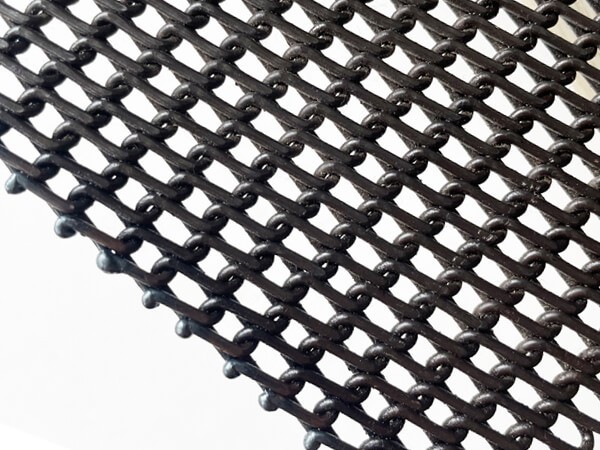
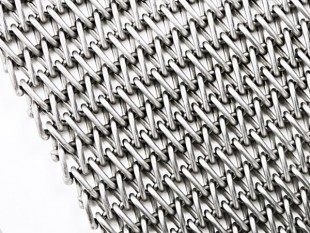
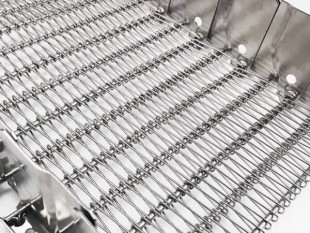
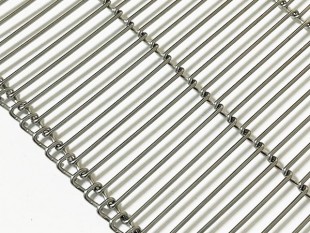
The belt is a stratified metal spiral conveyor belt of reduced thickness and low mass, engineered to deliver low heat inertia, high tensile strength, and consistent air circulation across the full belt width. The stratified spiral construction creates an overlapping wire structure with an open mesh. Standard configurations feature looped edges; welded edges are available on request.
The Biscuit Baking Belt is a stratified metal spiral belt with a light weight and a reduced thickness. Its design gives the belt low heat inertia, high strength and a good air circulation through the belt. This woven and stratified belt gives a super position of the wires and an open mesh. The edges are looped.
PFM Screen Biscuit Baking Belts are manufactured by passing a duplex unilateral spiral woven mesh through a precisely controlled rolling process, compressing the mesh to produce a completely flat, smooth carrying surface with a reduced overall belt thickness — without compromising heat transfer performance. The result is a belt of low mass and high tensile strength with excellent air permeability.
Inside the tunnel oven, the belt is friction-driven by a large-diameter drum, typically positioned at the outfeed end. This drum-drive system eliminates the lateral tension forces associated with sprocket-driven belts, contributing to the long service life of a correctly maintained baking band.
PFM Screen Biscuit Baking Belts are manufactured in carbon steel as standard — the preferred material for most biscuit tunnel ovens. Carbon steel's thermal properties promote consistent heat absorption through the belt surface, contributing to the characteristic embossed grid pattern on the underside of baked biscuits. Standard operating temperatures range from +200 °C to +275 °C; peak baking zone temperatures up to approximately +310 °C are achievable in high-temperature cracker and hard biscuit applications.
Stainless steel (SS304) is available on request, recommended for high-humidity ovens, steam-injected baking environments, or production lines requiring frequent chemical sanitisation between production runs.
The flat, uniform surface of the Rolled Baking Band delivers even heat transfer across the full belt width, making it the production standard for hard biscuits, crackers, cookies, and shortbread in straight-through tunnel ovens.
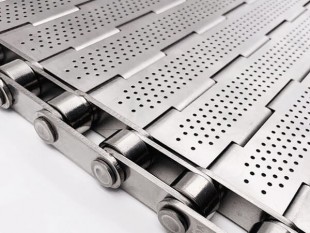
Note: Rolled Baking Bands are not recommended for soft doughs with a high fat content, where dough may flow into the open mesh during baking. For high-fat soft doughs and pastry products, a solid plate link or perforated steel band may be more appropriate. Contact us to confirm the correct belt type for your dough formulation and production line.
PFM Screen Rolled Baking Bands are in service in biscuit tunnel ovens worldwide, compatible with straight-through oven systems from all major biscuit line OEMs including Baker Perkins, Spooner Vicars, and Haas-Meincke. The Z47 is the most widely used specification and the global benchmark for high-volume biscuit production. Besides Z47, PFM Screen stocks Z47R, Z28, and Z48 — four standard specifications that differ in spiral pitch, wire diameter, belt pitch, belt thickness, and weight per square metre to suit different oven configurations and product ranges.
Rolled Baking Oven Belts Advantages:
PFM Screen Rolled Baking Bands deliver key performance advantages over solid steel bands and heavier compound weave belts in continuous tunnel oven applications.
The open mesh structure allows steam and gases released during baking to escape downward through the belt as well as upward. This two-direction venting prevents blistering on the biscuit base — a common quality defect on solid-band ovens — and produces a more uniform texture across the full batch width.
The rolled wire construction leaves the characteristic embossed grid pattern on the underside of each biscuit, a quality indicator associated with direct-on-belt baking that distinguishes the product from tray-baked or solid-band equivalents. The high air permeability of the open mesh promotes even heat circulation beneath the product, supporting consistent colour development, controlled moisture loss, and stable energy consumption across long production runs.
• High tensile strength and dimensional stability under continuous thermal cycling
• Low heat inertia — faster oven response and quicker changeover between products
• Excellent air permeability — even heat circulation and two-direction steam release
• Characteristic embossed grid base pattern — recognised quality mark for direct-baked biscuits
• Low mass, reduced-thickness construction — lower drive motor load and energy consumption
• Long service life with low maintenance requirements
• Looped or welded edge options to match oven tracking requirements
Edge Availability
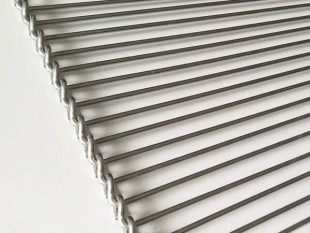
Biscuit Baking Belt with Welded Edges
Welded edge standard): The belt edge is welded to provide a rigid, reinforced border for applications with higher lateral tension or hard-guide tracking systems. Specify welded edges when ordering a replacement for an existing welded-edge belt to ensure compatibility with your oven's tracking system.
Material Availability
PFM Screen Biscuit Baking Belts are manufactured in high-quality carbon steel wire as standard, available in four standard specifications — Z47, Z47R, Z28, and Z48 — that differ in spiral pitch, wire diameter, belt pitch, and weight per square metre. This range covers the majority of straight-through tunnel oven configurations in commercial biscuit, cookie, and cracker production.
Stainless steel (SS304) is available on request for environments requiring corrosion resistance or compliance with specific food-safety cleaning protocols.
Specifications
The table below lists the four standard PFM Screen Rolled Baking Band specifications. All dimensions are nominal values for standard carbon steel manufacture; custom spiral pitch, wire diameter, and belt width are available on request.
Weight per square metre is a key selection factor: it directly affects the thermal mass of the belt and the energy required to reach and maintain operating temperature. Lower weight (Z28) favours short ovens and energy efficiency; higher weight (Z47R) favours heavy-load, high-intensity production.
To identify your existing belt specification, check the belt edge markings, refer to your oven manufacturer's technical documentation, or send us a photo of the belt end section.
NOTE:
Custom specification is available if you can't find the suitable size.
PFM Screen stocks four standard Rolled Baking Band specifications. Each is engineered for a different combination of oven type, belt speed, product range, and load requirement:
• Z47 (F4012) — The global benchmark for high-volume biscuit and cookie production. Spiral pitch 8.2 mm, wire diameter 1.2 mm, belt thickness 2.2 mm, weight 7 kg/m². The 8.2 mm spiral pitch delivers the industry-standard balance of open area, heat transfer, and belt weight. Suitable for high-speed, high-output continuous tunnel ovens at belt speeds up to 30 m/min. Widely used for crackers, cookies, hard biscuits, and digestives.
• Z47R (F4015) — A heavy-duty variant of Z47 with a thicker wire (1.5 mm vs. 1.2 mm) for improved shear resistance and extended service life. Weight: 11.2 kg/m². Specified for intensive-use production environments, high mechanical belt load, or where the Z47 experiences accelerated wear under demanding production conditions. • Z28 (F2510) — Fine-pitch, low-mass specification. Spiral pitch 6.3 mm, wire 1.0 mm, thickness 1.8 mm, weight 6.5 kg/m². The reduced wire diameter and low thermal mass mean the belt reaches operating temperature faster and requires less heat energy to maintain — the energy-efficient choice for shorter tunnel ovens and lighter production runs. • Z48 (F6014) — Wide-pitch specification with the most open mesh in the standard range. Spiral pitch 8.5 mm, wire 1.3 mm, belt pitch 6.7 mm, weight 7.4 kg/m². The larger belt pitch maximises air and heat circulation beneath the product surface. Best suited for flash baking applications and dense cracker formats requiring high-penetration heat from below.
Typical Applications
• Crackers and snack crackers — saltines, cream crackers, water crackers, wholegrain snack formats (Z47 standard; Z48 for flash-bake cracker lines) • Hard biscuits — digestives, Marie biscuits, tea biscuits, Nice biscuits, garibaldis, hard sweet biscuits • Cookies and shortbread — butter cookies, chocolate chip cookies, shortcake, drop cookies • Sandwich biscuit bases — the flat, uniform surface provides consistent dimensions for automated cream or jam layering • Rusk and crispbread — in high-temperature, low-moisture continuous baking applications • Soft biscuits — suitable where dough fat content does not cause mesh penetration
Common questions about Biscuit Baking Belts, Rolled Baking Bands, and Z47 oven belts
Q1. What is a Biscuit Baking Belt / Rolled Baking Band and how does it work?
A Biscuit Baking Belt — also called a Rolled Baking Band, Z-belt, or flat rolled baking belt — is a metal conveyor belt specifically designed for baking biscuits, cookies, and crackers directly on the belt surface inside tunnel ovens.
The belt is manufactured by linking carbon steel wire coils together to form a duplex unilateral spiral mesh, which is then passed through heavy-duty rollers several times to produce a completely flat, smooth surface with a reduced overall thickness. This rolling process is what gives the belt its characteristic "Z" cross-sectional profile and its names: Z-belt or Z47 (the most widely used specification).
• Flat, smooth carrying surface — supports both soft and hard doughs without sticking or deformation during baking. • Open mesh structure — gases and moisture escape downward through the belt as well as upward, preventing bubbles on the base of the biscuit and creating the characteristic grid pattern on the underside. • Low heat inertia — the light, reduced-mass construction heats up and cools down quickly, improving oven energy efficiency and allowing faster production changeovers. • Friction-driven — the belt is driven by a large-diameter drum, typically positioned at the oven outfeed, rather than by sprockets, which eliminates lateral tension and extends belt life.
PFM Screen Rolled Baking Bands are available in Z47, Z47R, Z28, and Z48 specifications in carbon steel, with stainless steel available on request.
Q2. What is the difference between Z47, Z47R, Z28, and Z48 baking belts?
The four standard Rolled Baking Band specifications differ in wire diameter, spiral pitch, belt pitch, and weight. Selection depends on the biscuit type, oven length, belt speed, and load requirements:
Z47 (F 4012) — The most widely used specification. Spiral pitch 8.2 mm, wire diameter 1.2 mm, belt pitch 5.4 mm, thickness 2.2 mm, weight 7 kg/m². Best choice for large, high-output biscuit ovens running at speeds up to 30 m/min. Suitable for hard biscuits, crackers, and cookies.
Z47R (F 4015) — A heavier-duty variant of Z47 with a thicker wire (1.5 mm vs 1.2 mm), giving improved shear resistance and a longer service life. Weight: 11.2 kg/m². Recommended for high-load applications, intensive use, or wherever the Z47 is experiencing accelerated wear.
Z28 (F 2510) — Finer mesh (spiral pitch 6.3 mm, wire diameter 1.0 mm, belt pitch 6.8 mm, weight 6.5 kg/m²). Ideal for lightweight short ovens and energy-saving applications where minimising heat loss is a priority.
Z48 (F 6014) — Larger spiral pitch (8.5 mm, wire diameter 1.3 mm, belt pitch 6.7 mm, weight 7.4 kg/m²) giving a more open mesh for improved air circulation. Suited to baking thick or hard biscuits where efficient heat transfer to the base is critical.
Custom specifications are available if none of the four standard models match your existing oven geometry or production requirements.
Q3. What temperature range can a Rolled Baking Band handle?
Standard carbon steel Rolled Baking Bands are rated for a continuous baking zone temperature of +200 °C to +275 °C, with peak temperatures reaching approximately 310 °C in some high-temperature biscuit oven configurations.
• Most biscuit and cookie production uses belt temperatures in the 200–260 °C range, well within the carbon steel specification. • High-temperature applications (crackers, hard biscuits) approaching 300 °C+ may require the heavier Z47R specification for improved longevity under thermal stress. • High-humidity applications (cheesecakes, soft-filled biscuits, steam-injected ovens) should specify stainless steel SS304 to resist corrosion from moisture and cleaning chemicals.
Please specify your oven zone temperatures and cleaning method when requesting a quotation, so we can confirm the correct specification.
Q4. Can Rolled Baking Bands be made in stainless steel?
Yes. While the standard and most common material for Rolled Baking Bands is carbon steel — which gives the characteristic biscuit base pattern and optimal heat transfer characteristics — PFM Screen can supply belts in SS304 stainless steel on request.
When to choose stainless steel: • High-humidity ovens — steam-injected baking environments where condensation causes carbon steel to corrode between production runs. • Products with high moisture content — soft-filled biscuits, cheesecakes, or steamed goods where water vapour is consistently high in the baking zone. • Aggressive cleaning regimes — where high-pressure washing with chloride-based chemicals is used routinely after each production shift.
Note that stainless steel Rolled Baking Bands have slightly different thermal transfer characteristics compared to carbon steel. Please discuss your application with our technical team before specifying SS304 for a new belt order.
Q5. What baked products can be produced on a Rolled Baking Band?
Rolled Baking Bands are designed for direct-on-belt baking of a wide range of dry and semi-dry dough products in continuous tunnel ovens:
• Hard biscuits and crackers — the most common application; Z47 is the industry standard for cracker and digestive-style production lines. • Cookies and shortbread — Z47 at high belt speeds up to 30 m/min. • Sandwich biscuits — the flat base pattern produced by the rolled mesh is consistent across the full belt width, aiding sandwich-cream adhesion. • Snack crackers — the open mesh provides even heat distribution beneath the cracker, preventing soft spots. • Wafers (partial) — some wafer production lines use Z-belts for pre-baking conveyance before transfer to wafer plates.
Not suitable for: Soft doughs with a high fat content where dough flows into the mesh during baking (e.g. some shortcrust pastry types). In these cases, a solid-surface plate link belt may be more appropriate.
Q6. What edge options are available for Biscuit Baking Belts?
PFM Screen Rolled Baking Bands are available with two edge configurations:
Looped edge — the standard configuration. The wire at each belt edge is bent into a smooth loop, which prevents unravelling and provides a clean, finished border. Most biscuit oven belts use looped edges. All four standard specifications (Z47, Z47R, Z28, Z48) are available with looped edges.
Welded edge — the belt edge is welded, giving a rigid, reinforced border for applications with higher lateral tension or where the belt tracks against hard edge guides. Specify welded edges when the oven design applies side forces to the belt edges.
If you are ordering a replacement belt, please specify the edge type of the existing belt to ensure compatibility with your oven's tracking and drive system.
Q7. How does a Rolled Baking Band attach to and drive in a tunnel oven?
Unlike sprocket-driven conveyor belts, Rolled Baking Bands use friction drive: the belt runs on a large-diameter smooth drum, most commonly positioned at the oven outfeed end. Friction between the drum surface and the belt surface propels the belt through the oven without any mesh-engagement mechanism.
• No sprockets required — simplifies the drive end and reduces wear points at the belt edges. • Large drum diameter — typically 300–600 mm depending on belt width and oven design — distributes the drive load evenly across the belt width. • Belt tension management — a second return drum at the oven infeed, plus tensioning rollers, maintains correct belt tension throughout the production run and through thermal expansion cycles.
When ordering a replacement Rolled Baking Band, please provide your existing belt width, length (or circumference for endless belts), and drum diameter so we can confirm the correct belt specification for your oven model.
Q8. How do I order a replacement Biscuit Baking Belt for my oven?
To order a replacement belt, please send us the following information via the enquiry form or by email to [email protected]:
• Belt specification — Z47, Z47R, Z28, Z48, or custom (check the existing belt or oven manual for the code; it is also marked on the belt edge in some cases). • Belt width — measured across the usable belt surface in millimetres. • Belt length — total belt length (or drum centre-to-centre distance and drum diameter if the exact belt length is unknown). • Edge type — looped or welded. • Material — carbon steel (standard) or SS304 stainless steel. • Quantity — number of belts required.
We also accept dimensional drawings and photos of the existing belt or oven drive end. Standard lead time for carbon steel Z47/Z47R belts is 2–3 weeks; custom widths or stainless steel may require additional lead time. Contact us for a free quotation.