Plate Link Conveyor Belts - Frequently Asked Questions
Common questions about plate link conveyor belts, hinged steel belts, and chip conveyor belts
Q1. What is a plate link conveyor belt, and how does it work?
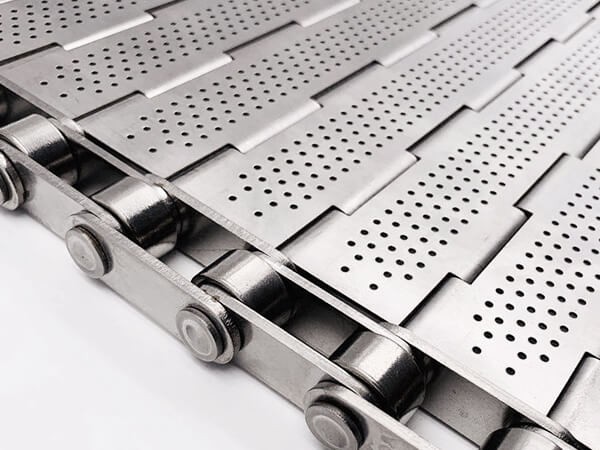
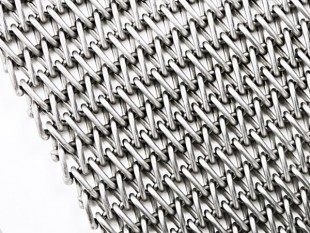
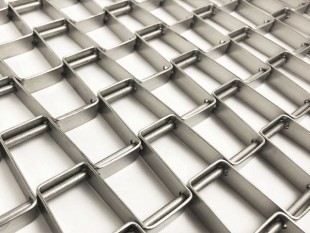
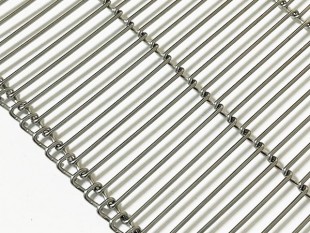
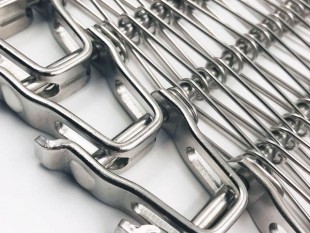
A plate link conveyor belt — also called a hinged steel belt, hinged slat belt, or chain plate belt — is a heavy-duty metal conveyor belt built from flat stainless steel or carbon steel plates (slats) joined by hinged side chains and connecting rods. The belt is positively driven by sprockets that engage the side chains directly, eliminating slip and ensuring reliable operation under heavy loads.
• Sprocket-driven positive drive — no belt slip under variable or heavy loads; precise, consistent tracking.
• Self-supporting plate structure — allows large belt widths to span the conveyor frame without intermediate support.
• Heavy load capacity — the robust hinged plate construction handles arduous processes including presswork, die-casting, and forging.
• Versatile construction — available in solid or perforated plate, with or without baffles, side plates, and cross flights.
PFM Screen manufactures plate link belts in 30 standard PLCB configurations with chain pitches from 25.4 mm to 125 mm and plate thicknesses from 1 mm to 4 mm.
Q2. What materials are plate link conveyor belts made from?
PFM Screen manufactures plate link conveyor belts in three material options:
SS304 (Stainless Steel AISI 304) — the standard grade for most applications. Excellent corrosion and heat resistance for food processing, washing, sorting, cooling, and general industrial environments.
SS316 (Stainless Steel AISI 316) — enhanced food-grade specification with added molybdenum, providing superior resistance to chlorides, acids, and aggressive sanitising agents. Recommended for seafood, dairy, meat processing, and high-temperature corrosive environments.
Carbon steel — available for cost-sensitive industrial applications where corrosion resistance is not a requirement.
Both stainless steel grades comply with food contact material regulations and are suitable for HACCP food safety management systems. Please specify your material requirement when requesting a quotation.
Q3. What is the operating temperature range of a plate link belt?
Plate link conveyor belts manufactured by PFM Screen can operate across a temperature range of -30°C to +600°C (-22°F to +1,112°F) — one of the widest temperature ranges of any conveyor belt type.
• Low-temperature applications (-30°C) — suitable for frozen food handling, blast freezing conveyors, and cryogenic processing lines.
• High-temperature applications (up to +600°C) — withstands the thermal demands of presswork, die-casting, forging, stamping, and industrial heat treatment processes.
• Food processing range — handles the full cycle of baking, pasteurising, blanching, cooling, and freezing on a single line type.
SS316 stainless steel is recommended for applications above 400°C or where the belt is exposed to corrosive gases or acidic environments at elevated temperature. Contact PFM Screen with your process temperature and environment details for material guidance.
Q4. What is a chip conveyor belt, and how is it related to plate link belts?
A chip conveyor belt — also called a swarf conveyor belt or metal chip belt — is a plate link belt specifically configured to collect and remove metal chips generated during CNC machining, turning, milling, drilling, and grinding operations.
• Same hinged plate structure — built on the identical plate link belt construction, dimensioned and configured for machine tool environments.
• Efficient chip removal — the hinged plate construction channels chips away from the machining area continuously without clogging.
• CNC machine compatibility — serves as a direct replacement or upgrade for OEM chip conveyors on CNC machining centres, lathes, and milling machines.
• Solid and perforated options — perforated chip belts allow cutting fluid to drain back into the machine sump while chips are carried away.
PFM Screen chip conveyor belts are available in the same 30 standard PLCB specifications as our plate link belt range. Custom pitch and width configurations for specific machine tool models are available on request.
Q5. Can plate link conveyor belts be made with perforated plates?
Yes. PFM Screen manufactures both solid-plate and perforated-plate variants of the plate link conveyor belt. Perforated plate belts allow liquid or air to pass freely through the belt surface during conveying.
• Washing and cleaning lines — water drains through the belt freely at all points along the line.
• Blanching and scalding systems — hot water or steam passes through the product layer evenly.
• Drying conveyors — through-air or hot-air systems circulate directly under and through the product.
• Sieving and grading — undersized product or debris falls through the perforation pattern during conveying.
• Drainage conveyors — food processing liquids and CNC cutting fluid drain back to the collection tank below.
Perforation hole diameter, spacing pattern, and open area percentage can be customised to match your specific process and product requirements. Curved perforated plate link belts are also available for conveyor systems requiring a curved path.
Q6. What standard chain pitches and specifications are available?
PFM Screen offers
30 standard PLCB configurations (PLCB-01 to PLCB-30), covering a wide range of chain pitches and plate thicknesses for different load and application requirements:
• 25.4 mm pitch — PLCB-01 to PLCB-03 (plate thickness 1–1.5 mm)
• 31.75 mm pitch — PLCB-04 to PLCB-06 (plate thickness 1–2 mm)
• 38.1 mm pitch — PLCB-07 to PLCB-11 (plate thickness 1–2 mm)
• 50.8 mm pitch — PLCB-12 to PLCB-16 (plate thickness 1.2–3 mm)
• 63.5 mm pitch — PLCB-17 to PLCB-19 (plate thickness 1.5–3 mm)
• 80 mm pitch — PLCB-20 to PLCB-23 (plate thickness 1.5–2.5 mm)
• 100–125 mm pitch — PLCB-24 to PLCB-30 (plate thickness 1.5–4 mm)
If your application requires a non-standard chain pitch, belt width, or plate thickness, PFM Screen can manufacture plate link belts to your specification. Submit your requirements to
[email protected] for a custom quotation.
Q7. What industries and applications use plate link conveyor belts?
Plate link conveyor belts are used across a wide range of industries wherever a robust, flat, high-load metal conveying surface is required:
Food processing — cooling systems, washing and cleaning lines, blanching conveyors, sorting and grading, drying systems, and bread or biscuit production lines.
Metalworking and engineering — CNC chip removal (swarf conveyors), presswork and stamping lines, die-casting plant conveyors, forging shop conveyors, and heat treatment lines.
Waste and environmental — waste treatment conveyors, recycling and sorting systems, and industrial drainage conveyors.
General industry — elevating and de-elevating systems, product transport conveyors, drainage systems, sieving and grading, and product handling lines.
The self-supporting plate structure of plate link belts allows large belt widths to span conveyor frames without intermediate support — a key advantage in wide-belt conveyor applications across all of the above sectors.
Q8. Can plate link conveyor belts be custom-made to specific dimensions?
Yes. PFM Screen manufactures plate link conveyor belts as tailor-made products in virtually any width and length. Customisable parameters include:
• Chain pitch — 25.4 mm to 125 mm standard; non-standard pitches on request.
• Plate thickness — 1 mm to 4 mm standard; heavier gauges on request.
• Belt width and length — to suit your conveyor frame dimensions.
• Perforation pattern — hole diameter, spacing, and open area percentage customised to your process.
• Edge configuration — standard chain edge or chain-edge plate with side plates.
• Cross flights — in various heights and thicknesses for inclined or elevating conveyors.
• Baffles and side guards — for sorting, product separation, and spillage prevention.
Contact PFM Screen at
[email protected] or via WhatsApp at +86-15369679157 with your application requirements for a custom quotation and lead time.
Q9. How is a plate link belt driven, and what is the maximum conveyor speed?
Plate link conveyor belts are positively driven by sprockets mounted on the drive shaft, which engage directly with the chain links on both edges of the belt. This positive drive mechanism is a key advantage over friction-driven belt types.
• No belt slip — direct sprocket-to-chain engagement eliminates the slip and tension problems that affect rubber and fabric belts at varying loads.
• Precise belt tracking — the positive drive keeps the belt running true on the conveyor frame without constant adjustment.
• Reliable under heavy loads — consistent drive force regardless of load variation along the belt length.
• Maximum speed — up to approximately 120 metres per minute, depending on the application, chain pitch, and load requirements.
Sprocket pitch circle diameter and tooth profile are matched to the PLCB chain pitch specification of the belt at the time of order. PFM Screen supplies matching sprockets for all standard PLCB configurations.
Q10. What edge configurations and accessories are available for plate link belts?
PFM Screen offers two standard edge configurations and a range of optional accessories:
Standard chain edge — bare chain links at both belt edges; the most common configuration for open or standard conveyor frames.
Chain edge plate — side plates welded to the chain for product containment, guiding, and spillage prevention along both belt edges.
Optional accessories available include:
• Cross flights — in various heights and thicknesses, for inclined or elevating conveyors to prevent product from sliding back.
• Baffles — attached to the plate surface for sorting, product separation, and controlled transfer.
• Side guards — for additional product spillage prevention on either side of the belt.
• Perforated plates — for drainage, through-air, or sieving applications (see Q5).
Chain fasteners — cotter pins or washers — are used at both belt edges, allowing individual belt sections to be disassembled without special tools for straightforward on-site maintenance and replacement.