Belt Types
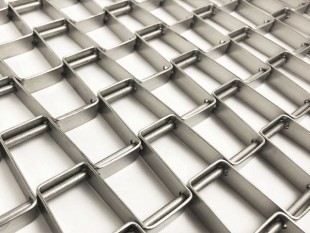
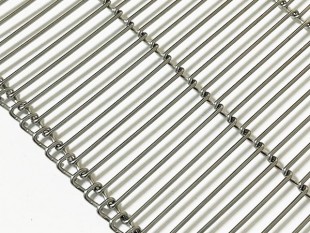
Eye link conveyor belts are available in six configurations. The basic spacer-free construction has no separate spacers or under-welded location wires; other versions use pressed eyes, welded modules, springs, bushings or washers to control the opening and support characteristics.
Select the construction by product size, required opening, cleaning access and conveyor duty. All types require belt support suited to the width and load. The absence of underside location wires does not remove this support requirement; repair access also depends on the cross rods and end retainers.

Full Eye Links
Adjacent links form a relatively close mesh without separate spacers. The opening depends on wire diameter and link geometry, providing flat product support with drainage and cleaning access. This is an option for suitable food-processing duties where a simple link arrangement is preferred. Repairs may require cross-rod removal and renewal of end retainers.

Pressed Eye Links
Flattening the eye portions reduces the opening between adjacent links. This configuration is used where small or fine products require closer support. Confirm the finished clear opening against the product dimensions.

Welded Eye Links
Eye links are welded to underside location wires to form modules with controlled spacing. Narrower gaps support smaller products, while wider gaps provide more open area. The construction avoids separate loose spacers, although welds and joints still require effective cleaning. Confirm the required clear gap and manufacturing tolerance separately.

Pressed and Welded Eye Links
Pressed eyes combine with welded positioning to provide stable modules with small, controlled openings. Modular assembly also permits wider belt constructions. Confirm gap dimensions, flatness and support requirements for the intended width.

Eye Links with Springs
Springs separate the links at regular intervals while allowing movement along the cross rod. Their spacing and compression characteristics must suit the required gap, loading and temperature changes. Exposed rod areas provide cleaning access; select the spring and link arrangement together for the operating duty.

Eye Links with Bushings or Washers
Bushings or washers separate the eye links to establish a defined gap. Larger openings provide more space for airflow and drainage, while the spacers add belt mass and contact surfaces. Select spacer dimensions and material for the required opening, product support and cleaning conditions.
Belt Type Selection Comparison
Compare how each construction controls the opening and supports the product. These selection guides do not replace the dimensional tables or confirmation of the final belt design.
|
Belt Type
|
Opening / Spacing Method
|
Selection Focus
|
What to Confirm
|
|
Full Eye Links
|
Adjacent links; no separate spacers. Opening follows wire diameter and link geometry.
|
Close product support with a simple spacer-free construction.
|
Check the finished clear opening, smallest product size and access for cross-rod repairs.
|
|
Pressed Eye Links
|
Flattened eye portions reduce the gap between adjacent links.
|
Smaller products requiring closer support.
|
Balance product retention with drainage and cleaning access; confirm the finished gap.
|
|
Welded Eye Links
|
Links are welded to underside location wires to form spaced modules.
|
A defined gap selected for product support, airflow or drainage.
|
Specify clear gap, welded-wire arrangement and tolerance; review cleaning around welds.
|
|
Pressed and Welded Eye Links
|
Pressed eyes combine with welded positioning to form close-spaced modules.
|
Small openings with stable link positioning, including suitable wide-belt constructions.
|
Confirm gap, module arrangement, flatness and conveyor support for the belt width.
|
|
Eye Links with Springs
|
Spring spacers separate the links while allowing movement along the cross rod.
|
Spacing arrangements that need controlled movement or resilience.
|
Review spring material, compression, gap stability, load and temperature changes.
|
|
Eye Links with Bushings or Washers
|
Solid spacers establish separation between the links.
|
Defined wider gaps for airflow and drainage where the product remains supported.
|
Select spacer size and material; account for added mass, contact surfaces and cleaning access.
|
Edge Availability

Eye Link Belt with Welded Edge
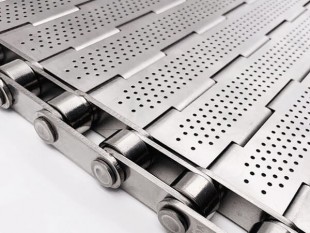
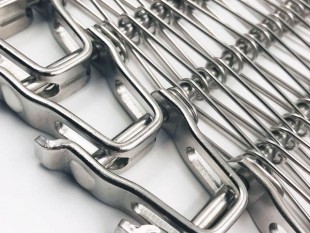
Plate links form the sides of the belt, while washers fitted to the cross-rod ends are welded in place to retain the links and finish the belt edges. The plate-link arrangement provides the edge-bearing surface required by the conveyor support design.
Where additional reinforcement is required, two or more rows of plate links can be arranged at the edges or at specified positions across the belt width. Their location and rod-end fastening details must match the belt construction, drive components and support arrangement.

Eye Link Belt with Chain Edge
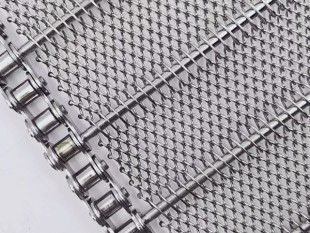
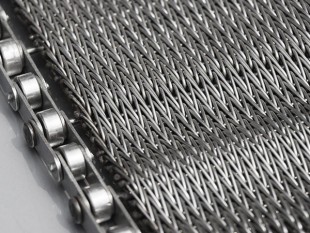
Hollow-pin side chains are connected to the belt by cross rods and engage matching chain sprockets for positive drive. Welded retaining rings or a suitable shouldered-rod arrangement locate the chains on the rods.
Select the chain pitch and size to suit the belt pitch, load and operating conditions. Confirm sprocket alignment, guide clearances and any reverse-bend requirements when integrating the chain-edged belt into the conveyor.

Eye Link Belt with Guide Plates Edge
Guide plates protect the welded rod ends at the belt sides by providing a contact surface between the weld heads and conveyor guides or adjacent structures. This helps shield the welds from direct rubbing where side contact can occur.
Plate dimensions and position are selected to suit the edge construction and available running clearance. Correct belt alignment and guide setup remain essential; guide plates protect the belt edge, while upright side guards serve to contain the product.
Side Guards and Flight Options
Configure edge plates and flights to retain products, separate lanes and manage product movement. These accessories are selected to suit the product, belt construction and conveyor layout.

Edge Plates / Side Guards
Edge plates form upright side guards that help keep products on the belt and contain the required product layer. Their height, profile and thickness can be selected for the product size, loading pattern and process. Intermediate guards can also form separate lanes across the carrying width to keep product rows apart.
Specify plate thickness, height above the carrying surface, profile and usable lane width, including any required overlap or clearance between adjacent plates. The guards must articulate around the drive and return components and remain accessible for cleaning. Check frame and transfer clearances when combining guards with flights.

Cross Flights / Product Alignment
Cross flights help position, separate and load products by forming barriers or shaped supports across the belt. On inclined conveyors, suitable flights help limit product sliding and carry products between levels. Flight profiles can also create defined spaces or pockets to hold individual products in position.
Specify flight thickness, height above the carrying surface, working width and spacing along the belt, together with product size, load and conveyor angle. Solid or open profiles and bolted, welded or wire-formed arrangements can be reviewed for the belt design. Check discharge, cleaning access and drive and return clearances.
Material Availability
Standard options include 304, 316 and 316L stainless steel and carbon steel. Other materials can be reviewed on request. Match the material to the product, cleaning chemistry and operating atmosphere.
|
Material
|
Wire Reference Temperature (°C)
|
|
Carbon Steel
|
550
|
|
304 Stainless Steel
|
750
|
|
316 Stainless Steel
|
800
|
|
316L Stainless Steel
|
800
|
Temperature selection: These wire temperatures are reference values, not continuous-duty ratings for a loaded conveyor belt. Confirm actual belt temperature, exposure time, atmosphere, load and heating/cooling cycles. Chains, joints, supports and drive components must also be suitable for the duty.
Specifications
-
A: Gap Width (mm)
-
B: Pitch (mm)
-
C: Cross Rod Dia (mm)
-
D: Underside Welded Wire Dia (mm)
-
E: Wire Link Dia (mm)
-
F: Reinforcing Plate Thickness (mm)
-
Overall Belt Width: Outside-to-outside width (mm)
A is the clear gap between adjacent links; B is the cross-rod pitch. C, D and E identify the cross-rod, underside welded-wire and eye-link wire diameters. F is reinforcing plate thickness. Overall Belt Width is labelled separately on the drawing. The illustrated 3+3+3+3 layout shows four groups of three reinforcing plate rows: two edge groups and two internal groups. Specify the required layout and positions; D and F apply only where those components are fitted. Also provide usable carrying width and full loop length.
Eye link conveyor belt without spacers
Each item row contains two alternative dimensional combinations: Set 1 on the left and Set 2 on the right. Select one complete pitch / wire diameter / cross-rod diameter combination. When enquiring, include the construction name, item number, set number and all three dimensions to identify the required belt.
|
Reference
|
Set 1 - dimensional combination
|
Set 2 - dimensional combination
|
|
Item No.
|
Belt Pitch (mm)
|
Wire Dia. (mm)
|
Cross Rod Dia. (mm)
|
Belt Pitch (mm)
|
Wire Dia. (mm)
|
Cross Rod Dia. (mm)
|
|
ELCB01
|
15.875
|
1.8
|
3.2
|
50
|
3
|
5
|
|
ELCB02
|
25
|
2
|
5
|
50.8
|
1.6
|
8
|
|
ELCB03
|
25.4
|
2
|
5
|
50.8
|
1.6
|
6
|
|
ELCB04
|
30
|
1.6
|
4
|
50.8
|
2
|
8
|
|
ELCB05
|
30
|
2
|
4
|
50.8
|
2.5
|
8
|
|
ELCB06
|
30
|
2
|
5
|
50.8
|
2.5
|
5
|
|
ELCB07
|
30
|
2
|
7
|
50.8
|
3
|
5
|
|
ELCB08
|
30
|
2
|
8
|
50.8
|
4
|
7
|
|
ELCB09
|
31.75
|
2
|
5
|
60
|
2
|
5
|
|
ELCB10
|
50
|
1.4
|
5
|
60
|
2.5
|
5
|
|
ELCB11
|
50
|
1.6
|
5
|
70
|
4
|
7
|
|
ELCB12
|
50
|
2
|
5
|
75
|
2.5
|
5
|
|
ELCB13
|
50
|
2.5
|
6
|
75
|
2.5
|
8
|
|
ELCB14
|
50
|
2.5
|
8
|
100
|
3
|
8
|
Eye link conveyor belt with under welded wire spacing
|
Item No.
|
Belt Pitch (mm)
|
Wire Diameter (mm)
|
Cross Rod Diameter (mm)
|
Minimum Gap Spacing (mm)
|
Gap in Steps of (mm)
|
Maximum No. of Welded Wires
|
|
ECBWWS01
|
15.875
|
1.8
|
3.2
|
2
|
0.1
|
1
|
|
ECBWWS02
|
25
|
2
|
5
|
2.3
|
0.1
|
2
|
|
ECBWWS03
|
25.4
|
2
|
5
|
2.3
|
0.1
|
2
|
|
ECBWWS04
|
30
|
2
|
4
|
2.3
|
0.1
|
2
|
|
ECBWWS05
|
30
|
2
|
5
|
2.3
|
0.1
|
2
|
|
ECBWWS06
|
50
|
2
|
5
|
2.3
|
0.1
|
3
|
|
ECBWWS07
|
50
|
2.5
|
5
|
2.8
|
0.1
|
3
|
|
ECBWWS08
|
50
|
2.5
|
6
|
2.8
|
0.1
|
3
|
|
ECBWWS09
|
50.8
|
2.5
|
8
|
2.8
|
0.1
|
3
|
|
ECBWWS10
|
50.8
|
3
|
8
|
3.3
|
0.1
|
3
|
|
ECBWWS11
|
75
|
2.5
|
5
|
2.8
|
0.1
|
3
|
|
ECBWWS12
|
75
|
2.5
|
8
|
2.8
|
0.1
|
3
|
“Gap in Steps of” describes the listed spacing increment, not a manufacturing tolerance. The maximum number of welded wires is a count and has no mm unit.
Eye link conveyor belt with springs as spacers
|
Item No.
|
Belt Pitch (mm)
|
Wire Diameter (mm)
|
Cross Rod Diameter (mm)
|
Minimum Gap Spacing (mm)
|
Gap Spacing also Available in these Widths (mm)
|
|
ECBWSS01
|
25
|
2
|
5
|
7
|
8
|
10
|
12
|
15
|
17.5
|
20
|
|
ECBWSS02
|
25.4
|
2
|
5
|
7
|
8
|
10
|
12
|
15
|
17.5
|
20
|
|
ECBWSS03
|
30
|
2
|
4
|
7
|
8
|
10
|
12
|
-
|
-
|
20
|
|
ECBWSS04
|
30
|
2
|
5
|
7
|
8
|
10
|
12
|
15
|
17.5
|
20
|
|
ECBWSS05
|
31.75
|
2
|
5
|
7
|
8
|
10
|
12
|
15
|
17.5
|
20
|
|
ECBWSS06
|
50
|
2
|
5
|
7
|
8
|
10
|
12
|
15
|
17.5
|
20
|
|
ECBWSS07
|
50
|
2.5
|
5
|
7.5
|
8
|
10
|
12
|
15
|
17.5
|
20
|
|
ECBWSS08
|
50
|
2.5
|
6
|
7.5
|
-
|
-
|
-
|
-
|
-
|
20
|
|
ECBWSS09
|
50
|
3
|
8
|
10.5
|
-
|
-
|
-
|
15.5
|
-
|
20
|
|
ECBWSS10
|
50.8
|
2
|
6
|
7
|
-
|
-
|
-
|
-
|
-
|
-
|
|
ECBWSS11
|
50.8
|
2
|
8
|
8
|
-
|
-
|
-
|
-
|
-
|
-
|
|
ECBWSS12
|
50.8
|
2.5
|
6
|
7.5
|
-
|
-
|
-
|
-
|
-
|
20
|
|
ECBWSS13
|
50.8
|
2.5
|
8
|
10
|
-
|
-
|
-
|
15
|
-
|
20
|
|
ECBWSS14
|
50.8
|
3
|
8
|
10.5
|
-
|
-
|
-
|
15.5
|
-
|
20
|
|
ECBWSS15
|
50.8
|
4
|
8
|
12
|
-
|
-
|
-
|
-
|
-
|
-
|
|
ECBWSS16
|
60
|
2.5
|
5
|
7
|
8
|
10
|
12
|
15
|
17.5
|
20
|
|
ECBWSS17
|
60
|
2.5
|
5
|
7.5
|
8.5
|
10
|
12
|
15
|
17.5
|
20
|
|
ECBWSS18
|
70
|
4
|
7
|
12
|
-
|
-
|
-
|
-
|
-
|
-
|
|
ECBWSS19
|
75
|
2.5
|
5
|
7.5
|
8.5
|
10
|
12
|
15
|
17.5
|
20
|
|
ECBWSS20
|
75
|
2.5
|
8
|
10
|
-
|
10
|
-
|
15
|
-
|
20
|
|
ECBWSS21
|
100
|
3
|
8
|
10.5
|
-
|
10.5
|
-
|
15.5
|
-
|
20
|
Dash entries mean that no option is listed in that position; they do not mean zero gap. When requesting a quotation, include the construction name, item number and complete dimensional combination.
Eye link conveyor belt with rings as spacers
|
Item No.
|
Belt Pitch (mm)
|
Wire Diameter (mm)
|
Cross Rod Diameter (mm)
|
Minimum Gap Spacing (mm)
|
Gap Spacing can be increased by (mm)
|
|
ECBWR01
|
25
|
2
|
5
|
4
|
2
|
|
ECBWR02
|
25.4
|
2
|
5
|
4
|
2
|
|
ECBWR03
|
30
|
2
|
4
|
4
|
2
|
|
ECBWR04
|
30
|
2
|
5
|
4
|
2
|
|
ECBWR05
|
31.75
|
2
|
5
|
4
|
2
|
|
ECBWR06
|
50
|
2
|
5
|
4
|
2
|
|
ECBWR07
|
50
|
2.5
|
5
|
5
|
2.5
|
|
ECBWR08
|
50
|
2.5
|
6
|
5
|
2.5
|
|
ECBWR09
|
50.8
|
2.5
|
6
|
5
|
2.5
|
|
ECBWR10
|
50.8
|
2.5
|
8
|
5
|
2.5
|
|
ECBWR11
|
50.8
|
4
|
8
|
8
|
4
|
|
ECBWR12
|
60
|
2
|
5
|
4
|
2
|
|
ECBWR13
|
60
|
2.5
|
5
|
5
|
2.5
|
|
ECBWR14
|
75
|
2.5
|
5
|
5
|
2.5
|
|
ECBWR15
|
75
|
2.5
|
8
|
5
|
2.5
|
Custom gap and belt dimensions can be reviewed against the product and conveyor requirements.
Need help specifying an eye link belt?
Send dimensions A-F where applicable, overall and usable belt width, full loop length, material and edge details. For a table reference, include the construction name, item number and complete dimensions; for the spacer-free table, also identify Set 1 or Set 2. Attach a marked drawing or photographs for confirmation.
 +86-15369679157