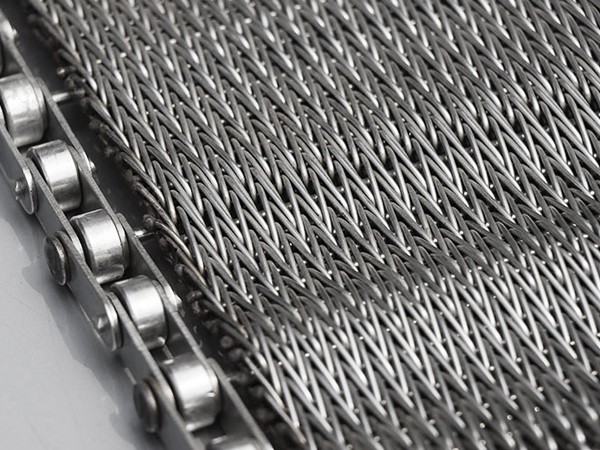
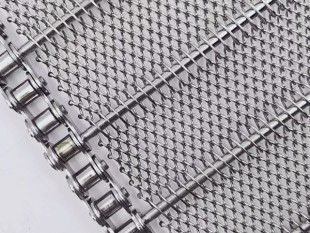
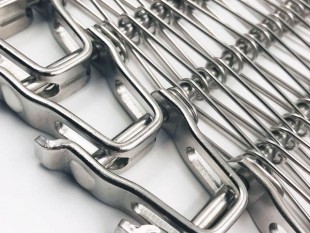
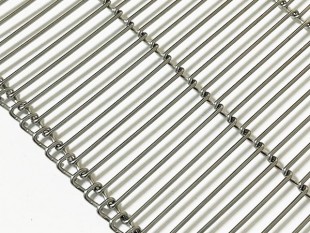
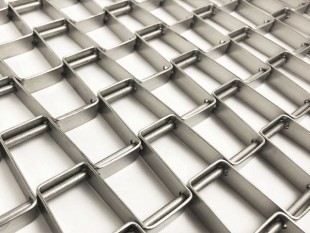
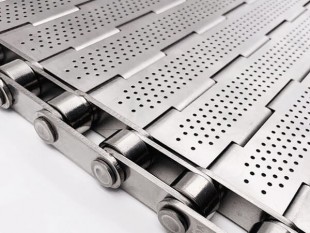
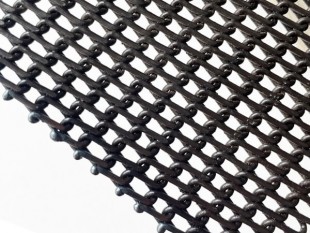
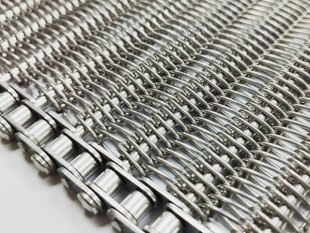
Compound Weave Conveyor Belt, also named Stainless Steel Cordweave Conveyor Belt, Compound Balanced Woven Belt,V-shaped Conveyor Belt or Baking Band Conveyor Belt, have right-hand and left-hand spirals interconnecting by straight cross rods.
The compound belt is a high-density, balanced spiral belt with multiple spirals and cross rods per pitch, resulting in minimal apertures and a flat surface. This structure ensures a close and flat mesh, ideal for conveying very small items. Its uniform heat transfer and smooth surface make it perfect for applications like biscuit baking and sorting small mechanical components. Popular for its durability and efficiency, the compound weave is a top choice in various industries, including food processing and precision manufacturing.
Generally, the material used to make the
Compound Weave Conveyor Belts is stainless steel or high carbon steel.
Compound weave conveyor belts made from 304 and 316 stainless steel are typically used in the food industry due to their hygienic properties, while those made from 310S and 314 stainless steel are preferred in the heat treatment industry for their high temperature and oxidation resistance.
310S and 314 stainless steel wire offer high temperature resistance, strong oxidation resistance, and excellent mechanical properties. These features make mesh conveyor belts made from 310S and 314 stainless steel ideal for addressing high temperature issues in powder metallurgy furnaces. These belts resist short cycles, peeling, and fractures, and can withstand temperatures up to 1000-1250°C.
Driving Methods
The belt can be driven by friction rollers or chains. In some cases, products
need to be upgraded or separated, and we can also provide cross flights and
side plates according to user needs.
Features of
Compound Weave Conveyor Belt
• Small open area. The compound weave conveyor belt has a little open area, which is
suitable to conveyor the small items.
• Use multiple
environments. High resistance against acid,
alkaline, chemical, abrasion, and corrosion.
• High tensile
strength. The compound weave conveyor belt has
multiple spirals and cross rods on each pitch, so it can supply higher tensile strength than other types of
conveyor belt.
• High-temperature
resistance. The compound weave conveyor belt is
made of high-quality materials, including stainless steel and nickel alloy
steel, which have excellent temperature resistance performance.
• Durable and long
service life. The unique structure and high-quality
material can ensure the long service life of compound conveyor belt.
• Uniform heating. Provides uniform heat transfer across the belt.
• Baffles can be
added. Different types of baffles can be added at
the both side and center of conveyor belt for sorting and conveying products.
In this format both coil and cross wires
are of round section.
Flat spiral wire compound weave conveyor
belt
In this format both coil and cross wires
are of flat section. These styles are most useful to gain more surface area
when handling small base area products.
Edge Availability
For the compound weave conveyor belt, we
can provide two different edge structures to meet different applications.
Compound weave conveyor belt with welded
edge
Compound weave conveyor belt with chain edge
Compound weave conveyor belt with side guard edge
Compound weave conveyor belt with folded side guard edge
Material Availability
The compound weave conveyor belt is made of
stainless steel and high carbon steel. They all have excellent high temperature
resistance performance and high tensile strength. All these can ensure the
compound weave conveyor belt be a strong, durable and high lifespan products.
NOTE: 1. If flat wire, please give us cross section.
2. Custom specification is available if you can't find the suitable size.
By offering a flat carrying surface with
little open area, Compound Weave Conveyor Belt is a popular choice for
applications as diverse as bottle-annealing to baking small snack products.
Compound Weave Conveyor Belt is particularly popular in baking applications as
its high-density construction ensures a uniform heat transfer through to the
product.
What is a compound weave conveyor belt, and what are its common names?
A compound weave conveyor belt — also called a compound balanced weave belt or CB belt — is a metal wire belt built from alternating left-hand and right-hand spiral coils, with multiple cross wires connecting adjacent spirals per pitch. The number of cross wires per coil (3, 4, or 5) defines the compound type and is the critical parameter when specifying a replacement or new belt.
Common names for the same belt construction:
• Compound Weave / Compound Balanced Weave Belt — generic industry name
• CB3 / CB4 / CB5 Belt — North American designation; the number equals the cross wires per coil
• Cordweave Belt — Wire Belt Company UK's registered trade name, widely used in the industry
• Baking Band / CB5 Baking Band — food industry name for oven-line applications
• V-shaped Conveyor Belt — refers to the herringbone surface pattern visible on the belt face
All names describe the same fundamental construction. Always confirm the CB compound number (3, 4, or 5) when ordering a replacement.
What is the difference between CB3, CB4, and CB5?
The CB number indicates the number of cross wires per spiral coil pitch. More cross wires means a denser mesh, lower flexibility, and a larger minimum drum diameter.
CB3 — 3 cross wires per coil: Highest flexibility. Minimum drum diameter 152 mm (6.00"). Suits tortilla ovens, small-drum conveyor layouts, and applications requiring the belt to wrap tightly around a small terminal roll.
CB4 — 4 cross wires per coil: Medium flexibility. Minimum drum diameter approximately 180–230 mm. The general-purpose compound weave specification for heat treatment of small components and fine-mesh food conveying.
CB5 — 5 cross wires per coil: Highest mesh density, lowest flexibility. Minimum drum diameter 273 mm (10.75"). The industry standard for cracker, biscuit, and cookie baking where maximum surface coverage and uniform heat transfer are required.
Rule of thumb: more cross wires = denser mesh = less flexibility = larger minimum drum diameter. Using a drive drum smaller than the specified minimum is the most common cause of premature wire fatigue failure at the drum contact point.
What material grade should I specify — food processing or high-temperature heat treatment?
Food processing and baking applications:
Stainless steel is mandatory for all food-contact belts. For standard baking, cooling, and drying at 200–300 °C, SS 304 is the correct standard choice (FDA and EC 1935/2004 compliant). Use SS 316 or 316L when chloride-based sanitisers are used regularly, or for seafood, brined products, or acidic food environments. SS 316L is preferred where the belt will be repair-spliced by welding.
Heat treatment and furnace applications:
• Up to 550 °C — Carbon Steel (lowest cost; no corrosion resistance)
• Up to 750–800 °C — SS 304 or SS 316 (standard heat treatment in air)
• Up to 1,100 °C — SS 310 (good for carburizing and nitriding atmospheres)
• Up to 1,120 °C — SS 314 / 1.4841 (note: avoid sustained 800–900 °C operation due to sigma-phase embrittlement risk; rapid passage through this range is acceptable)
• Up to 1,150 °C — Inconel 600 / 80/20 NiCr (sintering, brazing, and powder metallurgy furnaces)
Contact PFM SCREEN with your operating temperature, atmosphere type, and cycle profile to confirm the most suitable alloy.
What information do I need to provide to get a quotation?
To receive an accurate quote, please provide the following parameters:
• Compound type: CB3, CB4, or CB5
• Coil pitch (mm): centre-to-centre distance of adjacent coil wires across the belt width
• Coil wire diameter (mm): if flat wire, specify both width and depth (e.g. 1.6 × 1.3 mm)
• Cross wire pitch (mm): centre-to-centre of adjacent cross wires along the belt length
• Cross wire diameter (mm)
• Belt width (mm) and belt length (m)
• Wire material: 304SS / 316SS / 314SS / Inconel 600 / other
• Edge type: welded edge or chain edge
• Wire surface: round wire (standard) or flat wire (F)
• Application: brief description (baking, annealing, sintering, etc.)
If you have an existing belt, you can also send us an Ashworth CB part number, a Wire Belt CORD code, or photos and measurements of the worn belt — we will identify the equivalent and respond within 24 hours. Sample sections (300–600 mm × 200 mm) can also be supplied for specification confirmation before ordering.