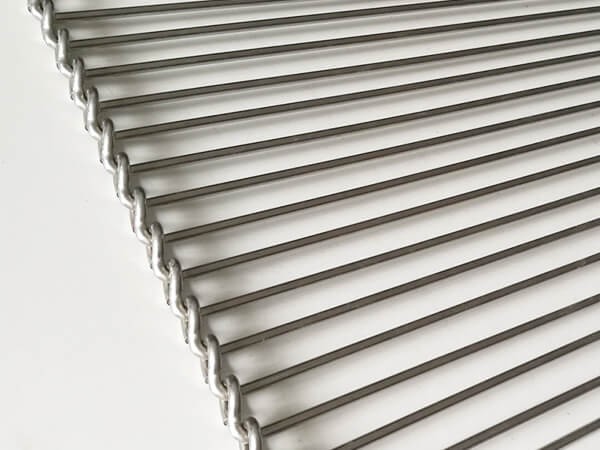
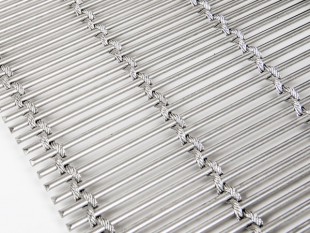
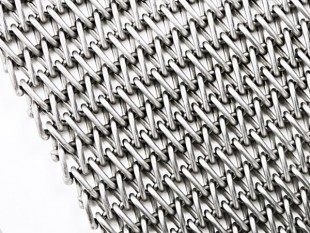
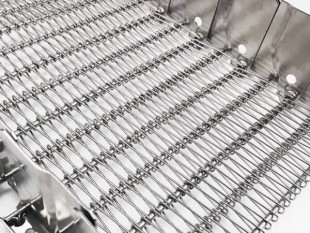
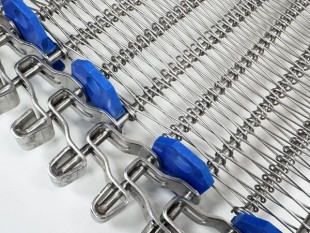
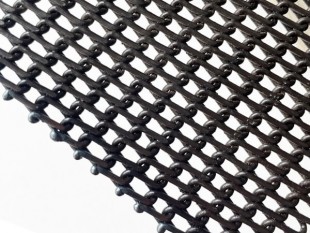
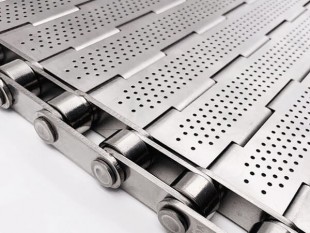
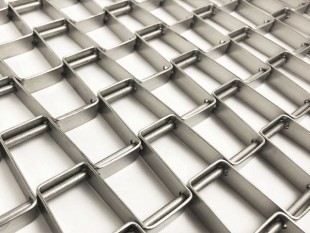
The ladder conveyor belt — also known as a rod conveyor belt or ladder track belt — is a positively sprocket-driven metal belt made from a series of parallel transverse rods connected at each end by S-shaped hooks, U-shaped links, or chain links. The fully open rod structure maximises airflow, drainage, and heat transfer through the belt surface, making ladder belts the standard choice for food processing lines requiring thermal performance and thorough cleanability.
PFM Screen ladder and rod conveyor belts are manufactured in food-contact-grade stainless steel 304 and 316, with carbon steel available for industrial applications. They are rated for continuous operation from -100°C to +450°C, supplied in straight-running and radial (curved) configurations, with custom widths and rod pitches matched to your equipment — sprockets included.
Ladder belts with S-shaped hooks or U-shaped links can be configured for both straight-running and radial (curved) conveyor paths with a fixed inside radius. A tapered rod-pitch assembly maintains consistent rod spacing and positive sprocket engagement through 90° or 180° conveyor turns. Chain-link ladder belts are manufactured for straight-running applications only.
Ladder Conveyor Belt Advantages
• Flat, level carrying surface — products are conveyed stably without rolling or slipping, even at continuous conveying speeds
• High-tensile rods resist permanent distortion — rods maintain consistent pitch under load, reducing belt stretch and unplanned downtime
• Positive sprocket drive eliminates tracking drift — the belt runs true without manual tracking adjustment, reducing operator intervention on long production runs
• Smooth rod edges for clean radial engagement — no catching or snagging as the belt passes through 90° or 180° curves
• Fully open rod structure — maximises airflow, steam, oil, and water passage directly through the belt for even heating, cooling, frying, and washing across the entire product base
• Fast field assembly and disassembly — the two-component construction (rods + links) allows individual belt sections to be replaced on the conveyor frame without specialist tools or full belt removal
• Food-grade material options — stainless steel 304 and 316 variants comply with food contact material requirements for HACCP-managed production environments
Belt Types
Ladder belt with S-shaped hooks
These belts are designed for straight-running applications and can also be configured as curved (radial) belts with a fixed inside radius. Available in right-hand (clockwise) or left-hand (anti-clockwise) arrangements. Standard curved belts are supplied for 90° or 180° conveyor turn angles. The S-hook configuration is the most widely specified ladder belt variant for general food processing, bakery cooling, and washing line applications.
Ladder
belt with U-shaped links
These belts run in both straight-line and curved applications. Available in right-hand (clockwise) or left-hand (anti-clockwise) arrangements for 90° or 180° conveyor turn angles. The U-link construction provides a slightly larger link profile than S-hooks, offering additional lateral stiffness on wide belt configurations — commonly specified for batter-coating and heavy product washing applications.
Ladder
belt with chain links
Ladder Belt with Chain Links These belts are designed for straight-running applications only. The chain-link construction provides the highest tensile load capacity of the three ladder belt variants, making it the preferred specification for heavy-duty straight-run conveyor systems handling dense or high-mass products. Chain-link ladder belts are not available in curved (radial) configurations.
• Stainless Steel 304 (SS 304) — the standard specification for food processing, bakery, and general industrial applications. Excellent corrosion and oxidation resistance, rated for continuous operation from -100°C to +450°C. Compatible with HACCP food safety management systems.
• Stainless Steel 316 (SS 316) — the food-grade marine specification with added molybdenum, providing superior resistance to chloride-based cleaning agents, saline environments, and acidic food products. Recommended for seafood processing, dairy production, and any application using aggressive CIP chemicals.
• Mid-tensile Carbon Steel — for high-load non-food industrial applications where stainless steel is not required. Lower material cost; not recommended for food contact environments.
• Other materials (including high-carbon steel and special alloys) are available on request. Please specify your required material grade and operating environment when enquiring.
● Bakery cooling lines — bread, buns, pastry, and baked goods cool rapidly and evenly through the open rods after leaving the oven. The sprocket-driven belt maintains constant speed without slipping, ensuring consistent throughput on high-volume production lines.
● Donut and food frying lines — the open rod structure allows hot cooking oil to circulate freely around the product, producing even frying results on both sides. Raised rod flight belt variants keep individual products separated and prevent stacking in the fryer.
● Baking, grilling, and tunnel oven conveying — the open rod surface allows direct heat and hot-air jet contact with the underside of the product at continuous belt temperatures up to +450°C.
● Batter-coating systems (batter belts) — for breaded and battered products, the ladder belt can be reinforced with bar links and lateral side chains to increase stiffness, preventing the soft product from falling through the rod gaps during the coating and frying stages.
● Food washing and blanching systems — water, steam, and cleaning solutions drain freely through the belt at all points along the line. The fully open construction leaves no pooling zones and simplifies CIP wash-down between production batches.
● Drying tunnel conveyors — airflow reaches the product from directly below the belt surface for rapid, even moisture removal.
● Product grading and sorting installations — rod spacing acts as a natural size-grading gap; smaller items pass through while correctly sized products continue to convey. Common in fruit, vegetable, and seafood processing lines.
● Filtering installations — the consistent rod-pitch spacing enables precise mechanical separation of solids from liquids or smaller particles in industrial filtering processes.
Common questions about ladder conveyor belts, rod belts, and sprocket-driven stainless steel belting
Q1. What is a ladder conveyor belt and how does it work?
A ladder conveyor belt is a metal belt constructed from a series of parallel horizontal rods — resembling the rungs of a ladder — connected at each end by S-shaped hooks, U-shaped links, or chain links. The belt is positively driven by sprockets that engage the link connections, ensuring accurate, slip-free tracking without the need for manual adjustment.
The fully open rod structure allows air, steam, water, oil, and heat to pass freely through the belt surface. This makes ladder belts well suited to a wide range of food and industrial processes:
• Bakery cooling systems — bread, pastry, and baked goods cool evenly through the open rods after leaving the oven. • Donut and food frying lines — the open structure allows hot oil to circulate freely around the product for even frying results. • Washing systems — water and cleaning solutions drain freely through the belt at all points along the line. • Batter-coating applications — excess batter drains through the belt cleanly, preventing buildup on the belt surface. • Drying tunnels and grilling systems — heat and airflow reach the product directly from below the belt surface.
PFM Screen ladder belts are rated for temperatures from -100℃ to +450℃ and are available in stainless steel 304, stainless steel 316, and carbon steel. Custom widths and pitches are supplied with matching sprockets.
Q2. What is the difference between S-hook, U-link, and chain-link ladder belts?
The three variants differ in their side-linking method and the conveyor path geometry they support:
S-hook (S-shaped hook) belts — run in straight applications and can also be configured as curved (radial) belts with a fixed inside radius for 90° or 180° conveyor angles. Available in right-hand (clockwise) or left-hand (anti-clockwise) arrangements.
U-link belts — can run in both straight and curved applications. Available in right-hand or left-hand arrangements for 90° or 180° turns, the same as S-hook variants.
Chain-link belts — designed for straight applications only. These provide the highest tensile load capacity of the three variants and are the preferred specification for heavy-duty straight-run conveyors.
For applications requiring a curved conveyor path, specify either S-hook or U-link when requesting a quotation. Please note the required turn angle (90° or 180°) and hand (right or left) at time of enquiry.
Q3. Can ladder conveyor belts run in curved or radial conveyor applications?
Yes. Both S-hook and U-link ladder belts can be manufactured as curved (radial) belts with a fixed inside radius, suitable for 90° or 180° conveyor turns. A tapered rod-pitch assembly maintains consistent rod spacing through the bend, giving smooth drive engagement around the entire curve.
PFM Screen standard radial ladder belt models:
• RLB01 — Pitch 12.7 mm | Rod Ø 3.66 mm | Inside Radius 598.5 mm | Available widths: 229 / 305 / 381 / 457 / 762 mm • RLB02 — Pitch 15.87 mm | Rod Ø 4.47 mm | Inside Radius 762 mm | Available widths: 305 / 381 / 457 / 610 / 762 mm
Custom inside radii and belt widths are available on request. Chain-link ladder belts are limited to straight-running applications only.
Q4. What temperature range can stainless steel ladder conveyor belts withstand?
PFM Screen ladder belts in stainless steel 304 or 316 are rated for continuous operation across a temperature range of -100℃ to +450℃. This covers the full span of food and industrial process temperatures:
• Cryogenic environments — freezing tunnels and cryogenic cooling systems operating as low as -100℃. • Ambient processes — washing, conveying, and product sorting at room temperature. • High-temperature processes — bakery ovens, industrial fryers, drying tunnels, and grilling systems up to +450℃.
Carbon-steel ladder belt variants are also available for high-load, non-food industrial applications where stainless steel is not required. Please specify your operating temperature range when requesting a quotation.
Q5. Are ladder conveyor belts food-safe for bakery and frying applications?
Yes. PFM Screen ladder belts are manufactured from food-contact-grade stainless steel 304 or 316 (SS 304 / SS 316) — the standard materials for direct food contact in processing environments worldwide. The open rod construction provides three key hygiene advantages over solid-surface belts:
• Free drainage — water, oil, and food residues pass through the belt freely, preventing pooling and contamination buildup on the belt surface. • Easy CIP access — the open structure provides unobstructed access for clean-in-place (CIP) spray systems from both above and below the belt. • Rapid drying — the open rod surface dries quickly between production batches, reducing the risk of bacterial growth between production runs.
Typical food processing applications include bread and pastry cooling lines, donut frying conveyor systems, batter-coating belts, fish and seafood processing, vegetable blanching, product washing systems, and food drying tunnels. SS316 is recommended for environments using aggressive chloride-based sanitising chemicals.
Q6. What standard specifications are available for ladder conveyor belts?
Straight-running Ladder Belts (SRLB Series)
Item No.
Pitch (mm)
Rod Diameter (mm)
Max Width (mm)
SRLB01
12.7
3.66
762
SRLB02
15.87
4.47
914
SRLB03
19.05
4.88
914
SRLB04
25.4
4.88
914
Radial (Curved) Ladder Belts (RLB Series)
Item No.
Pitch (mm)
Rod Ø (mm)
Inside Radius (mm)
Available Widths (mm)
RLB01
12.7
3.66
598.5
229 / 305 / 381 / 457 / 762
RLB02
15.87
4.47
762
305 / 381 / 457 / 610 / 762
Custom pitches, rod diameters, belt widths, and raised rod flight belt variants are available on request. Contact us or download the enquiry form for a custom specification and free quote.
Q7. What is a raised rod flight belt and when should I use one?
A raised rod flight belt is a ladder belt variant in which selected rods are elevated above the standard rod plane at regular, customer-specified intervals. These raised flights serve two purposes:
• Product retention on inclined sections — the raised flights prevent items from sliding backward when the conveyor is running at an angle, maintaining controlled product flow without requiring a separate hold-down belt. • Product spacing through thermal processes — the flights keep individual food items separated during frying, grilling, or blanching to ensure even heat or oil exposure across every piece.
Raised rod flight belts are commonly specified for donut production lines, fish-frying conveyor systems, snack food lines, and other applications where products require controlled separation and retention through high-temperature processing stages. Please specify flight height and spacing interval when requesting a quotation.
Q8. How do I specify and order a custom ladder conveyor belt?
To receive an accurate quote and free technical drawings within 24 hours, please provide the following details when you contact us:
• Belt path — straight running or radial (curved); if curved, the required turn angle (90° or 180°) and hand (right / left). • Link type — S-hook, U-link, or chain link. • Dimensions — belt width (mm) and total conveyor length (mm or metres). • Specifications — rod pitch (mm) and rod diameter (mm), or the existing item number (e.g. SRLB02) if replacing a worn belt. • Material grade — stainless steel 304, 316, carbon steel, or other material on request. • Operating temperature — minimum and maximum process temperature. • Application — product being conveyed and any food-safety or hygiene certification requirements.
Download the Ladder Conveyor Belt Enquiry Form from the Downloads tab above, or contact us directly: