Product Description
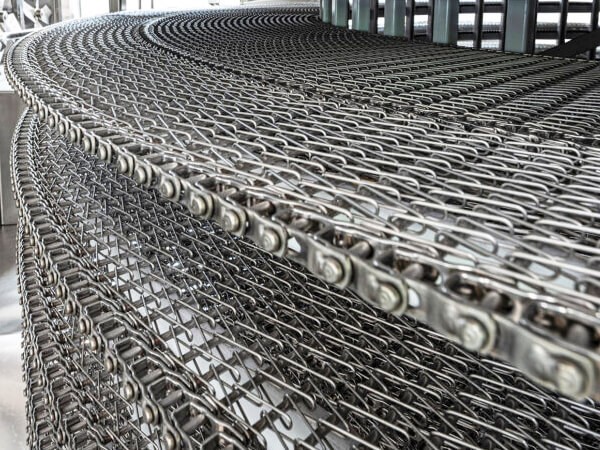
A spiral freezer belt is the mechanical core of any spiral freezing or cooling system. It carries product continuously in a vertical helical path — from infeed at ground level through multiple stacked tiers — while high-velocity refrigerated air passes freely through the open mesh at every level. The belt must maintain stable tracking and link engagement at operating temperatures as low as −40 °C, withstand full production loads without sagging or misalignment, and survive daily CIP chemical cleaning cycles across its full service life. PFM Screen manufactures spiral freezer belts in food-grade SS304 and SS316 stainless steel, in all three major belt configurations, for new spiral systems and as direct replacements for existing equipment.
Construction and Airflow
PFM Screen spiral freezer belts are manufactured to tight dimensional tolerances: rod pitch, link pitch, and wire diameter are controlled to ±0.1 mm to ensure accurate sprocket engagement, correct turn ratios, and consistent product support across the full belt width. Each belt is finished with welded edges to eliminate sharp rod ends that can abrade belt guides or injure maintenance personnel during installation. Turn ratios from 1.6 to 2.5 are available to match your drum diameter and belt width combination precisely.
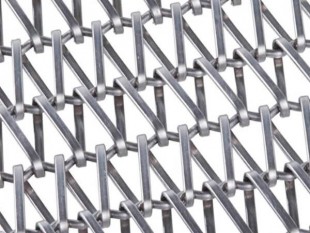
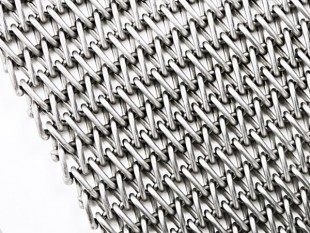
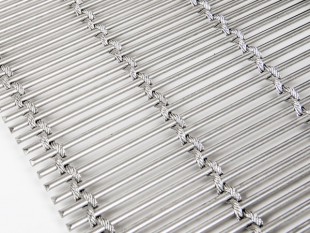
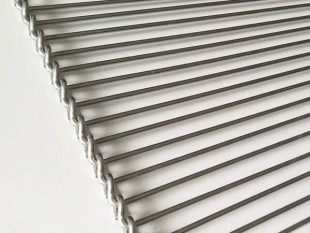
The open rod-and-link mesh structure allows refrigerated air to penetrate every belt tier from both above and below the product layer, enabling rapid, even heat extraction — the essential mechanism behind consistent IQF quality, uniform cooling curves, and reduced product weight loss during freezing.
Spiral Freezer Belt Configurations
PFM Screen supplies three belt types to cover the full range of spiral conveyor drive systems used in commercial food processing. Selecting the correct type depends on your equipment's drive mechanism, throughput requirement, and hygiene access constraints:

Standard Spiral Freezer Belts

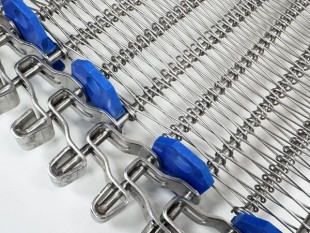
Standard Spiral Freezer Belts with Center Chains

Standard Spiral Freezer Belts without Mesh Cover

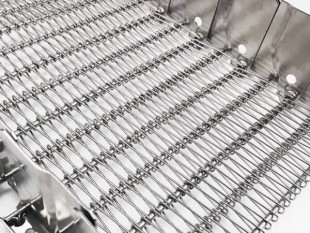
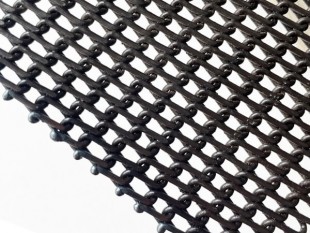
Standard Spiral Freezer Belts with Side Guard Chains
Features & Benefits
• Sub-zero structural stability: Maintains full belt geometry, link engagement, and tracking at continuous operating temperatures down to −40 °C without metal fatigue or link deformation across service life.
• Open mesh for maximum IQF airflow: The open rod-and-link structure allows high-velocity refrigerated air to circulate through every belt tier, enabling uniform, rapid freezing with minimal moisture loss and no product sticking.
• Food-grade materials: SS304 and SS316 stainless steel are uncoated metals without binders; metal release depends on the food-contact and cleaning conditions. Both grades comply with EU 1935/2004 and FDA 21 CFR food contact regulations. Material test certificates available on request.
• Daily CIP cycle compatible: Belt surfaces and internal link structures withstand steam cleaning, clean-in-place chemical circulation, and standard food-safe sanitiser concentrations without surface degradation or link corrosion.
• Matching sprockets and drive components supplied: Sprockets, side guards, and replacement belt sections available at the time of belt order, eliminating multi-supplier coordination delays.
How to Choose the Right Spiral Freezer Belt
Selecting the correct spiral freezer belt requires matching five parameters to your equipment:
1. Drive system type: Standard belts require a centre drum or cage; edge drive belts require edge chain/sprocket assemblies; self-stacking belts are fully self-supporting. Fitting the wrong type to your drive causes immediate tracking failure.
2. Belt width and turn ratio: For spiral runs, specify both the straight-run belt width and the turn ratio (inside turn radius ÷ belt width, range 1.6–2.5). An incorrect turn ratio causes lateral belt migration and accelerated edge wear.
3. Rod pitch: Must match the drive sprocket tooth pitch where sprocket drive is used (standard values: 19.05, 25.4, 27.4, 30, 30.5, 38.1 mm). A pitch mismatch causes sprocket jump and rapid drive wear.
4. Material grade: SS304 for most IQF and cooling applications to −40 °C. SS316 for seafood, dairy, meat, and any line using chloride-based CIP chemicals daily.
For chloride-based or bleach cleaning, SS316 is not immune to pitting: confirm chemical concentration, temperature and contact time, and rinse thoroughly after cleaning.
5. For replacement orders: Provide equipment make/model, belt width, rod pitch, wire diameter, and total belt length. Photographs of the existing belt and drive interface allow PFM Screen to confirm the correct specification before production.
Contact [email protected] with your equipment specifications for a technical review and quotation.
Replacing Your Existing Spiral Freezer Belt
PFM Screen supplies replacement spiral freezer belts for systems from all major equipment manufacturers, including Ashworth, JBT (Frigoscandia), Starfrost, Eurotek, and others. Replacement orders account for the majority of spiral belt purchases — a belt typically requires replacement every 3–7 years depending on throughput, cleaning cycle frequency, and product abrasiveness.
To ensure a correct like-for-like replacement, provide as much of the following as available:
• Equipment make and model (e.g. "JBT GYRoCOMPACT 600", "Starfrost Helix")
• Belt width (straight-run section, in mm or inches)
• Rod pitch (centre-to-centre, in mm)
• Rod and wire diameters
• Spiral Coil Pitch
• Turn ratio or drum diameter
• Total belt length (from maintenance records)
If documentation is unavailable, photographs of the existing belt in situ and of the drive interface allow PFM Screen's engineering team to identify the correct specification. Matching sprockets are available at the time of belt order. Replacement belt lead time is confirmed in the quotation for the selected specification. Contact wirebelt@pfmscreen.com to begin a replacement review.
Why Choose Us?
• 30+ years manufacturing stainless steel conveyor belts for the global food processing industry
• Exported to 60+ countries across Europe, North America, Southeast Asia, the Middle East, and Oceania
• OEM and retrofit supply: belts manufactured to your existing system's specifications, compatible with all major spiral freezer brands
• Matching sprockets and side guards available at time of belt order
• Standard lead time confirmed in the quotation; expedited production available on request
• Material certificates and dimensional drawings provided with every order
Need a spiral freezer belt matched to your system?
Send your equipment make and model, belt width, rod pitch, turn ratio and photos of the existing belt and drive interface.
 +86-15369679157