Edge Drive Spiral Freezer Belts - Frequently Asked Questions
Common questions about edge drive spiral freezer belts, IQF freezing systems, spiral coolers, and stainless steel belt specifications
Q1. What are Edge Drive Spiral Freezer Belts and how does the edge drive system work?
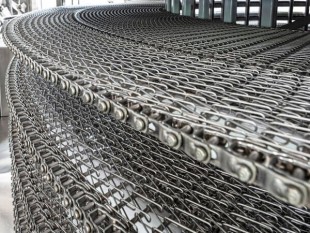
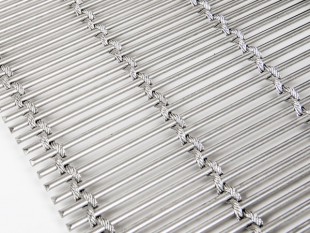
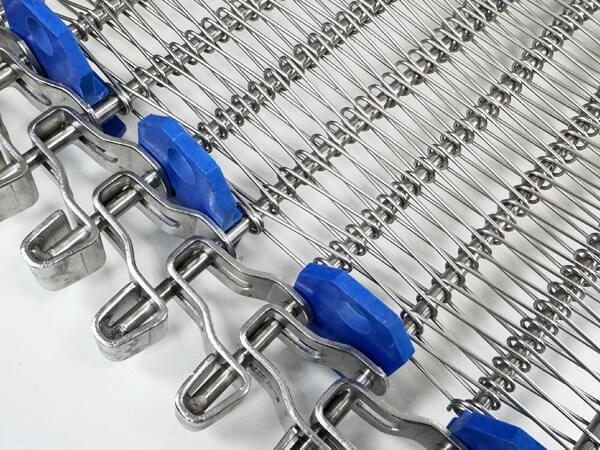
An Edge Drive Spiral Freezer Belt is a stainless steel mesh conveyor belt driven through engagement at the belt edge. Drive force is transmitted through cage bars or sprockets that engage the reinforced belt edge or side links, depending on the system design as the belt travels upward or downward through the spiral tower.
Key advantages of the edge drive mechanism:
• Positive belt tracking — continuous cage or sprocket engagement at the belt edge helps reduce lateral drift and mistracking when alignment, engagement and operating loads are within the specified limits.
• Compact spiral footprint — the spiral path provides a long conveying run within a compact floor area; the drum or sprocket position depends on the equipment design.
• Even tension distribution — drive engagement at the belt edge provides controlled force transmission through the belt structure, reducing mesh fatigue and extending service life.
• IQF (Individual Quick Freezing) performance — consistent belt tension combined with open-mesh airflow exposure supports rapid, even heat extraction, meeting IQF product separation standards without clustering.
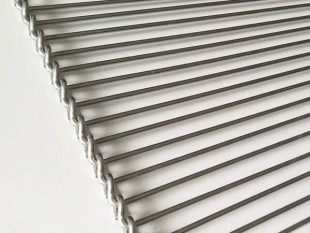
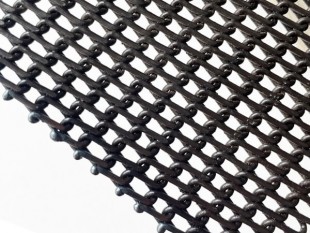
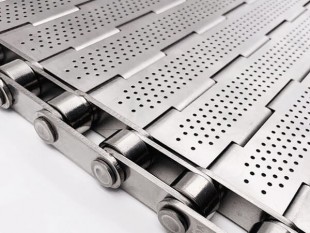
PFM Screen Edge Drive Spiral Freezer Belts are manufactured in balanced weave, ladder mesh, and hybrid configurations to suit specific product types, airflow targets, and OEM machine specifications. Custom widths, rod pitches, and drive component matching are available.
Q2. What is the difference between an Edge Drive and a Self-Stacking Spiral Freezer Belt?
Both belt types are used in spiral freezer towers, but edge drive describes force transmission and self-stacking describes tier support; the two terms are not mutually exclusive:
Edge Drive Spiral Freezer Belt:
• Driven by a cage drum or sprocket arrangement that acts directly on the belt edge.
• Active, positive drive — reinforced belt edges or side chain links engage mechanically with cage bars or sprockets for precise belt control.
• Belt tracking depends on correct drive engagement, guidance and alignment; tier-support arrangements depend on the equipment.
• Better suited to high-speed, high-throughput IQF lines processing heavier products such as poultry cuts, fish fillets, burger patties, and sausages where positive belt control is critical.
Self-Stacking Spiral Belt:
• The belt tiers support one another through purpose-designed stacking elements; the drive arrangement is equipment-specific.
• A separate tier-support structure may be unnecessary, but a mechanical drive is still required; stacking pressure does not generate drive power.
• Simpler external drive mechanics; preferred for lighter, fragile products such as individual pastries, cream cakes, or delicate seafood portions where gentle handling is the priority.
Edge drive systems deliver superior belt control and higher throughput. Self-stacking systems offer simpler mechanics for lighter-duty or fragile-product lines. PFM Screen manufactures both types; contact us to confirm which architecture suits your production requirements.
Q3. What food products are processed on Edge Drive Spiral Freezer Belts?
Edge Drive Spiral Freezer Belts are used across a wide range of IQF (Individual Quick Freezing), blast freezing, spiral cooling, and spiral proofing applications:
• Seafood — fish fillets, shrimp, scallops, squid rings, crab portions, and mixed shellfish in IQF tunnel and spiral freezer systems.
• Poultry and meat — chicken pieces, whole legs, sausages, burger patties, meatballs, and beef cuts requiring rapid core temperature reduction to meet food safety hold times.
• Bakery and baked goods — par-baked bread, pastries, croissants, pizza bases, tortillas, and filled buns requiring blast freezing immediately after the oven or proofing stage.
• Ready meals — portion-packed entrées, pre-cooked rice dishes, proteins, and complete frozen dinner components.
• Dairy and desserts — individually wrapped ice cream bars, cream-filled pastries, and cut cheese portions.
• Vegetables — blanched and IQF frozen peas, corn, carrot slices, green beans, and mixed vegetable blends.
Products that must achieve IQF status — where each individual piece freezes separately without clustering or sticking — are particularly well-suited to edge drive systems. The open mesh belt combined with controlled cold air delivery ensures even, rapid heat extraction from all product surfaces simultaneously.
Q4. What stainless steel grades are available, and when should I specify SS316?
PFM Screen Edge Drive Spiral Freezer Belts are available in two food-grade stainless steel specifications:
AISI 304 (SS304) — the standard grade for most spiral freezer and cooler applications. Provides excellent corrosion resistance and mechanical strength across the operating temperature range (-40°C to +260°C). Compatible with standard CIP sanitisers and approved for HACCP-certified food production. Suitable for most poultry, bakery, vegetable, and ready-meal processing environments using conventional cleaning chemicals.
AISI 316 (SS316) — the marine and food-grade specification with added molybdenum, providing superior resistance to chloride ions and aggressive acid-based cleaning chemicals. SS316 is recommended for: seafood processing lines (high-salt and brine environments); meat and poultry plants using hypochlorite (bleach) or peracetic acid sanitisers; coastal or high-humidity installations with elevated ambient chloride levels; and any environment where aggressive sanitisation protocols are required to meet food safety standards.
Both grades comply with EU food contact material regulation EC No. 1935/2004 and are compatible with FDA 21 CFR food-contact metal requirements. Material test certificates and compliance documentation are available on request for food safety audits. Specialised alloys (Inconel, Monel) are available for non-standard temperature or chemical environments on request.
For bleach or other aggressive cleaning chemicals, SS316 is not immune to corrosion. Confirm the cleaning concentration, temperature and contact time for the selected belt material.
Q5. What specification parameters can be customised for Edge Drive Spiral Freezer Belts?
PFM Screen manufactures Edge Drive Spiral Freezer Belts to exact customer specification. The following parameters can be configured to match your machine requirements:
• Belt width — 310 mm to 1,200 mm standard range; non-standard widths available on request.
• Rod pitch — 31.75 mm (1¼ inch, standard North American specification) and 34 mm (common European specification); other pitches available for OEM matching.
• Rod diameter — 5.0 mm or 6.0 mm; heavier diameters for high-load applications such as whole poultry or large meat cuts.
• Coil wire diameter — 1.5 mm, 1.6 mm, 1.7 mm, or 2.0 mm, selected to balance mesh density, open area percentage, and load-bearing capacity.
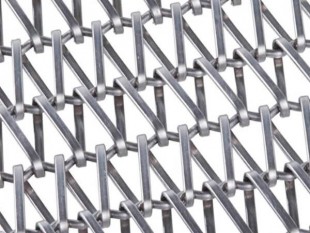
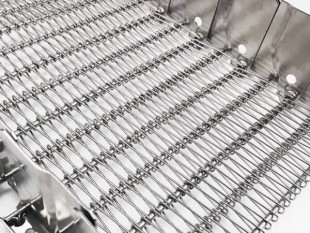
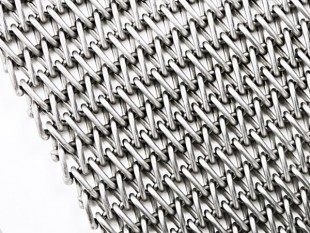
• Mesh type — balanced weave (versatile, good combination of airflow and product support), ladder mesh (maximum open area for rapid heat transfer), or hybrid patterns for specific product requirements.
• Edge construction — welded edge matched to the cage-bar or sprocket drive interface; optional integrated edge guard to prevent product slippage at belt edges.
• Connection type — welded or hooked cross-rod connections, selected according to required belt flexibility and load rating.
• Sprocket and cage bar matching — drive components engineered to match your existing cage drum geometry or sprocket rail for drop-in belt replacement without frame modification.
Please provide your existing belt width, rod pitch, mesh type, and OEM machine model when requesting a replacement belt quotation to confirm dimensional compatibility.
Q6. Which spiral freezer OEM systems are Edge Drive Spiral Freezer Belts compatible with?
PFM Screen Edge Drive Spiral Freezer Belts are manufactured to the rod pitch, belt width, mesh type, and edge construction specifications required by all major spiral freezer OEM platforms, including:
• GEA Refrigeration — spiral freezer and spiral cooler systems (Aerofreeze, Crystalfreezer, and custom configurations).
• JBT Corporation — GyroChill and Frigoscandia-heritage spiral freezer and IQF cooler range.
• Starfrost — Helix and custom spiral tunnel IQF freezer systems.
• Dantech / DACS — DanIce and spiral IQF freezer range.
• Northfield Equipment — industrial spiral freezer and proofing systems.
• Heinen Freezing — spiral and tunnel IQF systems.
Replacement belts are fabricated to match the original OEM specification for rod pitch, belt width, coil wire diameter, and edge construction, ensuring drop-in compatibility without modifications to drive components or spiral frame geometry. To confirm specification matching for your machine, please provide the OEM model number, current belt width, rod pitch, and mesh type when making your enquiry.
Q7. How are Edge Drive Spiral Freezer Belts cleaned and maintained?
Stainless steel Edge Drive Spiral Freezer Belts are engineered for efficient HACCP-compliant sanitation using standard food industry cleaning methods.
Routine shift-end cleaning:
• Flush the belt surface with warm water (40–60°C) after each production shift to remove surface food residue and ice buildup.
• Apply an approved food-grade detergent by spray or foam; allow contact dwell time as specified by the chemical supplier.
• Rinse thoroughly. The open mesh structure allows cleaning solution and residue to drain freely through the belt without pooling.
CIP (Clean-in-Place) compatibility:
• Fully compatible with automated CIP systems and high-pressure hot water washdown at temperatures up to 90°C.
• For hypochlorite (bleach) cleaning, SS316 offers improved corrosion resistance but is not immune to pitting. Peracetic acid is not a chlorine-based sanitiser. For either chemical, confirm compatibility, concentration, temperature and contact time, and follow the chemical supplier’s rinsing instructions.
Planned maintenance inspection:
• Inspect edge welds, cage bar joints, and cross-rod connections for fatigue, deformation, or corrosion at each scheduled maintenance window.
• Check the cage drum or sprocket rail for uneven wear patterns that could cause belt mistracking or uneven tension distribution across the belt width.
• Individual rod-by-rod repair or section splicing can extend belt service life; full belt replacement is recommended at first signs of systematic edge weld fatigue, mesh distortion, or progressive cage bar wear.
Specifying SS316 material from the outset and maintaining a regular inspection schedule are the two most cost-effective measures for maximising Edge Drive Spiral Freezer Belt service life in aggressive production and cleaning environments.
Q8. What is the lead time for Edge Drive Spiral Freezer Belts, and how do I request a quotation?
Standard specification Edge Drive Spiral Freezer Belts in AISI 304 — common widths 310–1,200 mm, rod pitch 31.75 mm or 34 mm — are typically available within
3–5 weeks from order confirmation. Custom widths, non-standard rod pitches, AISI 316 material, or OEM-matched cage bar specifications may require
5–8 weeks, depending on configuration complexity and current production schedule.
To obtain an accurate quotation and confirmed lead time, please provide:
• Belt width (mm or inches)
• Rod pitch (mm or inches)
• Estimated belt length required, or number of tiers
• Stainless steel grade: SS304 or SS316
• Mesh type: balanced weave, ladder mesh, or hybrid
• Drive system type: cage bar drive or sprocket drive
• OEM machine make and model (for replacement belt orders)
• Annual quantity or framework order volume for volume pricing consideration
Submit your requirements via the Enquiry Form PDF (available for download on this page), email us at
[email protected], or contact us directly by WhatsApp or phone at +86-15369679157. Our technical team will confirm specification compatibility and provide a quotation within one business day.
Still have a question about your edge drive belt?
Send your equipment model and belt details. Include photos, operating conditions and your replacement requirements.
 +86-15369679157

 Edge Drive Spiral Freezer Belts


 、
、