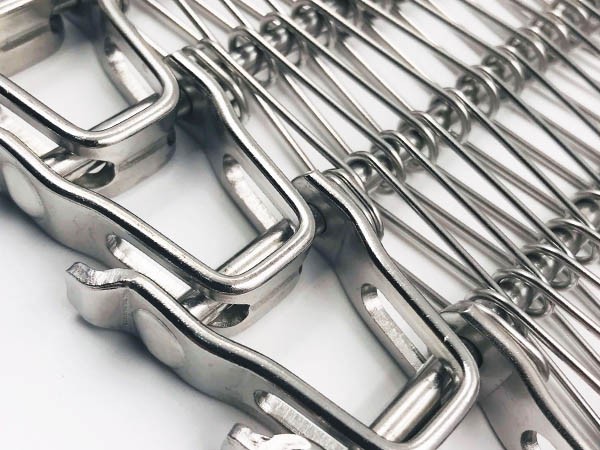
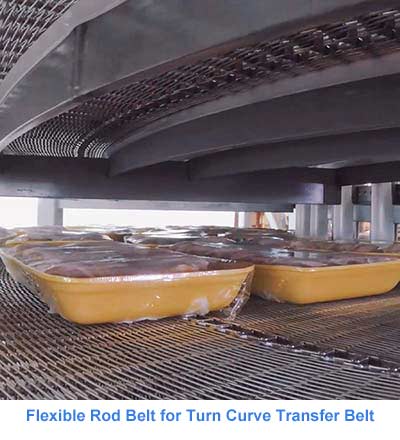
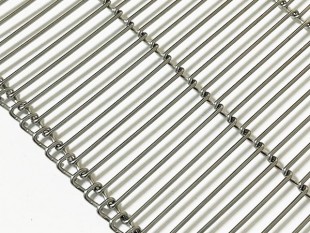
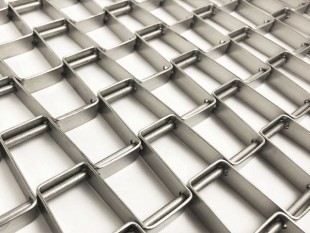
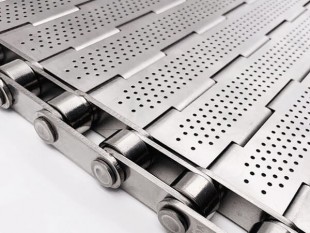
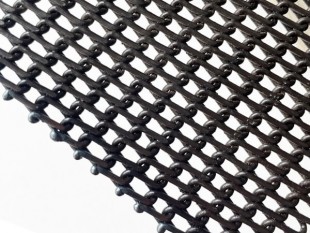
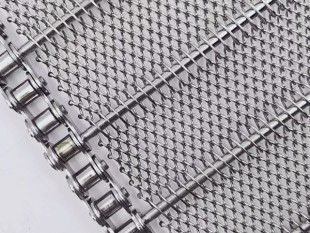
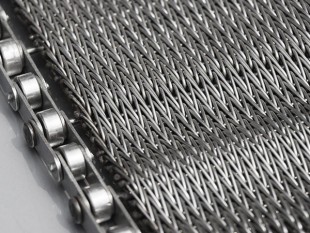
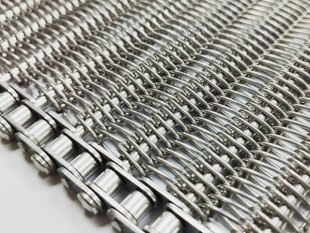
The Flexible Rod conveyor belt is the industry standard for spiral tower and radius conveyor systems in food processing. Constructed from three interlocking components — alternating stainless steel spiral coils, smooth cross rods, and drive-engaging edge chain links — the belt's defining capability is side-flex: the ability to navigate curves, spirals, and 90°/180° bends without product transfers or directional restrictions.
PFM Screen Flexible Rod belts are supplied in SS304 and SS316 stainless steel, in standard and heavy-duty edge configurations, with available widths from 305 mm to 1,524 mm for straight runs and up to 1,371.6 mm for spiral and curve runs. Custom dimensions are vailable on request.
Owing to their robust welded construction, PFM Screen Flexible Rod belts require minimal maintenance over a long service life — fewer unplanned stoppages, lower replacement frequency, and greater production uptime. The alternating coil-and-rod structure eliminates flex fatigue points found in woven belt designs, extending belt life in 24/7 spiral freezer and cooker environments.
For spiral towers with compact drum diameters, Flexible Rod belts can be supplied with an additional U-shaped link at the centre of the belt width. This center-link configuration reduces the turn ratio to 0.8 – 2.1, enabling the belt to navigate substantially tighter curves than the standard configuration (turn ratio 1.6 – 2.5). Side guards can be added to both belt edges to prevent product spillage on incline or high-speed sections.
• Smooth and burr-free. The finish is smooth and burr-free for quick and easy cleaning, maximizing production.
• High temperature resistance. The stainless steel material can maintain the perfect performance even in the extremely high or low temperature applications.
• Corrosion and rust resistance. The stainless steel material and galvanized steel have excellent chemical stability, which are corrosion and rust resistance.
• Durable and long service life. The high quality material and rigid structure can ensure the long lifespan of the flexible rod conveyor belt.The welded cross-rod-and-coil structure eliminates flex fatigue points, delivering long service life in continuous 24/7 spiral freezer and cooking line operation.
• Quick to install and replace. Modular cross-rod construction allows damaged sections to be replaced without removing the full belt from the conveyor frame, minimising production downtime.
• U-shaped links can be added on the center of conveyor belt. To decrease turning radii and improve conveying efficiency, the U-shaped conveyor belt are added onto the center of the conveyor belt.
• Side guards are available. Side guards can be added on both side of the conveyor belt to prevent products from spillage.
• Open-rod surface with maximum ventilation. The rod-and-coil structure provides an open, mesh-free upper surface, maximising airflow around large-format products such as bread loaves, shoulder hams, and whole poultry.
Flexible Rod Belt edge has different types, which can be standard U-shaped link and U-shaped link edge with reinforced rod. they're all solid and sturdy. you can choose them according to your applications and products you want to convey.
Flexible Rod Belt with standard U-shaped link edge
Flexible Rod Belt with standard U-shaped link and reinforced plate
Material Availability
Material: carbon steel, SS 201, SS 304, SS 316, SS 316L
Material
Maximum Wire Operating Temperature °C
Recommended Use
Carbon Steel
550
Industrial ovens, non-food applications
201 Stainless Steel
600
General industrial; moderate corrosion exposure
304 Stainless Steel
750
Standard food-grade: freezing, cooling, proofing, cooking
Specifications of Flexible Rod Conveyor Belt with link in the middle
Technical Specifications
Popular Value
Coil Wire Diameter
1.2mm, 1.4mm, 1.5mm, 1.6mm, 2.0mm
Cross Rod Diameter
4.9mm, 5.0mm, 5.9mm, 6.0mm
Edge Links Height
11.1mm, 12.7mm, 15mm
Cross Rod Pitch
19.1mm, 27.4mm
Available Widths
305-1219 mm
Turn Ratio
0.8-2.1
Method of Drive
Sprocket driven on links
NOTE: Custom specification is available if you can't find the suitable size.
The Flexible Rod Belt is a versatile conveyor belt. This belt has been developed for a variety of applications, constructions and process conditions. Whether used on spiral or straight conveyors, the Flexible Rod Belt is particularly suitable for cooking, cooling or freezing products such as bread, pastry, vegetables, potatoes, fish and meat. It can also be used for blanching vegetables, proofing dough, drying, baking or pasteurising. Belts are used in concentric systems, spiral towers, curved and straight conveyors.
Flexible Rod Conveyor Belts - Frequently Asked Questions
Common questions about Flexible Rod conveyor belts, radius belts, and side-flex wire mesh belts for spiral and curved conveyor systems
Q1. What is a Flexible Rod conveyor belt and how is it constructed?
A Flexible Rod conveyor belt — also known as a radius belt or side-flex belt — is a stainless steel wire mesh conveyor belt built from three interlocking components:
1. Alternating spiral coils — formed from coil wire (diameter 1.2 mm – 2.0 mm), the spirals interlock to form the open mesh surface that carries product. 2. Smooth cross rods — stainless steel rods (diameter 4.9 mm – 6.0 mm) pass through the interlocked coils, holding the belt structure together while allowing the belt to articulate laterally without deforming. 3. Edge chain links — U-shaped links fitted at the outer ends of each cross rod along both belt edges. They lock the cross rods in position with button heads, form the drive engagement surface for the sprockets, and provide the lateral tension that enables side-flexing.
This three-component architecture gives the Flexible Rod belt its defining capability: side-flex — the ability to travel through curves, spirals, and 90°/180° bends without product transfers or directional restrictions. It is the standard belt type for spiral towers and radius transfer conveyors in food processing.
PFM Screen Flexible Rod belts are available in carbon steel, SS201, SS304, SS316, and SS316L, in standard and heavy-duty link configurations, with matched sprockets supplied.
Q2. What are the main applications for Flexible Rod conveyor belts?
Flexible Rod conveyor belts are used wherever a conveyor must navigate a curved or spiral path, or where large volumes of product must be processed in a compact production footprint.
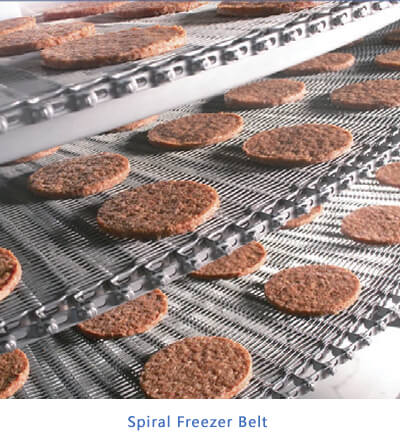
• Spiral freezing — meat patties, fish fillets, prawns, pizza, and ready meals are frozen on a single continuous belt run through a multi-tier blast-freezer or cryogenic tunnel, with no product transfers between tiers. • Spiral cooling — freshly baked bread, rolls, cakes, and pastries are cooled gradually in a temperature-controlled spiral environment without belt-to-belt transfers that can damage fragile product. • Spiral proofing — dough pieces are held in a heated, humidity-controlled spiral proofer for precise, consistent proofing times before baking. • Spiral cooking and pasteurisation — meat, fish, and vegetables are cooked or pasteurised in a heated spiral tunnel at controlled throughput rates. • Blanching — vegetables, fruits, and seafood pass through a hot-water or steam blanching stage; the open wire structure allows full liquid contact with the product surface at all points. • Radius transfer conveyors — the belt negotiates 90° and 180° corner turns in compact production lines, replacing multiple straight conveyor sections and eliminating belt-to-belt transfer points. • Drying and baking — product passes through a spiral dryer or oven tunnel; the open rod surface allows hot air to circulate directly around and beneath the product.
The Flexible Rod belt also operates on straight-running conveyors, making it a versatile single belt type across mixed production lines.
Q3. What is the difference between a standard Flexible Rod belt and a center-link Flexible Rod belt?
The two configurations differ in their minimum turning radius — the key dimension that determines what spiral drum diameters and curve radii the belt can navigate.
Standard Flexible Rod belt (links at both sides only)
Edge chain links are fitted at both outer edges of the belt only. The belt achieves a turn ratio of 1.6 – 2.5. This covers the great majority of commercial spiral tower and radius conveyor layouts and is the standard specification for most spiral freezer, cooler, and proofer applications.
Center-link Flexible Rod belt (links at both sides + one in the middle)
An additional U-shaped link is fitted at the centre of the belt width. This centre link distributes the lateral compressive load across the belt width, allowing the inner edge to collapse to a tighter radius. The result is a turn ratio of 0.8 – 2.1 — substantially tighter than the standard configuration.
Choose the center-link configuration when: • A spiral tower has a compact or unusually small drum diameter. • A radius conveyor must negotiate a tight 90° turn within a restricted plant floor area. • The equipment OEM specifies a minimum turning radius that the standard belt cannot achieve.
Center-link belts are available in widths from 305 mm to 1,219 mm, with cross rod pitches of 19.1 mm and 27.4 mm. Download the center-link enquiry form and provide your drum diameter and belt width to confirm the correct specification.
Q4. What materials are available and what temperatures can Flexible Rod belts handle?
PFM Screen Flexible Rod conveyor belts are available in five material grades to match your process temperature and chemical environment:
• Carbon Steel (max 550 °C) — industrial ovens and non-food environments. • SS 201 Stainless Steel (max 600 °C) — general industrial use with moderate corrosion exposure. • SS 304 Stainless Steel (max 750 °C) — the standard food-grade specification for spiral freezing, cooling, proofing, and cooking. • SS 316 Stainless Steel (max 800 °C) — recommended for seafood, dairy, and meat processing where chloride-based cleaning agents are used regularly. • SS 316L Stainless Steel (max 800 °C) — as SS316; preferred where post-weld corrosion resistance at welded joints is a concern.
SS 304 is the standard specification for most food processing environments including spiral freezers, coolers, proofers, and straight-run cooking conveyors.
SS 316 / SS 316L is recommended where the belt is regularly exposed to chloride-based sanitising agents (hypochlorite, quaternary ammonium compounds), acidic marinades, or high-salinity processing conditions — typical in seafood, meat, and dairy lines. The added molybdenum content provides significantly higher pitting corrosion resistance compared to SS 304.
Please specify your required material grade when requesting a quotation. Material test certificates are available on request.
Q5. What edge types are available for Flexible Rod conveyor belts?
PFM Screen Flexible Rod belts are supplied with two edge configurations:
Standard U-shaped link edge — a U-shaped chain link is press-fitted at each end of the cross rod along both belt edges, locked in position with a button head. This is the universal standard for the great majority of spiral and radius conveyor applications. The U-link forms the drive engagement surface for the sprocket and provides the lateral tension that enables side-flexing.
U-shaped link with reinforced plate — a steel reinforcement plate is inserted inside the U-link at each belt edge, distributing load across a wider bearing surface and improving fatigue resistance under high-cycle or heavy-load service conditions. Recommended for: • High-speed spiral freezers running continuous 24-hour production cycles. • Applications where product loading per metre of belt width is above average. • Situations where maximising belt service life between replacements is the primary objective.
If you are unsure which edge configuration is correct for your equipment, please provide your spiral tower drum diameter, belt width, product weight per square metre, and line speed, and PFM Screen will confirm the appropriate specification.
Q6. What widths and cross rod pitches are available for Flexible Rod conveyor belts?
PFM Screen supplies Flexible Rod belts in two configuration families:
Standard configuration (links at both sides) — turn ratio 1.6 – 2.5 • Coil wire diameter: 1.2 mm, 1.4 mm, 1.5 mm, 1.6 mm, 1.7 mm, 2.0 mm • Cross rod diameter: 4.9 mm, 5.0 mm, 5.9 mm, 6.0 mm • Cross rod pitch: 19.05 mm, 25.4 mm, 27.4 mm, 30 mm, 30.5 mm, 38.1 mm • Belt width — curve / spiral run: 304.8 mm – 1,371.6 mm • Belt width — straight run: 304.8 mm – 1,524 mm
Center-link configuration (links at both sides + centre) — turn ratio 0.8 – 2.1 • Coil wire diameter: 1.2 mm, 1.4 mm, 1.5 mm, 1.6 mm, 2.0 mm • Cross rod diameter: 4.9 mm, 5.0 mm, 5.9 mm, 6.0 mm • Cross rod pitch: 19.1 mm, 27.4 mm • Belt width: 305 mm – 1,219 mm
Custom dimensions outside these standard ranges are available on request. To specify a replacement belt, download the relevant Enquiry Form and provide your cross rod pitch, edge link height, belt width, and (for spiral/curve applications) the conveyor drum diameter.
Q7. How are Flexible Rod conveyor belts driven, and will they fit my existing sprockets?
Flexible Rod belts are sprocket-driven on the edge chain links. The sprocket teeth engage directly with the U-shaped links at each end of the cross rods, providing positive, slip-free drive without requiring friction contact between the belt surface and any roller or drum.
This positive sprocket-drive method is essential in spiral conveyor applications. In a spiral tower with 20 or more tiers, precise belt tension and consistent speed must be maintained throughout the full loop — this is only reliably achievable with positive sprocket engagement at the belt edge, not friction drive.
Fitting to existing sprockets (replacement belts):
The critical matching dimension is the cross rod pitch (centre-to-centre spacing of adjacent cross rods). The sprocket tooth pitch must match the belt cross rod pitch exactly. Edge link height also determines sprocket tooth engagement depth and must be confirmed.
• For replacement belt orders: provide cross rod pitch, edge link height, belt width, and drum diameter (for spiral / curve runs). PFM Screen will confirm sprocket compatibility before production. • For new installations: PFM Screen supplies matched drive and idler sprockets for all standard Flexible Rod belt configurations and can manufacture sprockets to non-standard dimensions on request.
Contact us with your existing belt specifications or conveyor drawings for a direct compatibility assessment.
Q8. Are Flexible Rod conveyor belts food-safe and HACCP-compliant?
Yes. PFM Screen Flexible Rod belts in SS304 and SS316 stainless steel are fully compatible with HACCP (Hazard Analysis and Critical Control Points) food safety management systems and are in active use in certified food processing facilities across more than 60 countries.
• Non-toxic, food-safe construction — food-grade stainless steel wire and cross rods contain no coatings, binders, or substances that can migrate into food. Compliant with international food contact material standards including EU Regulation (EC) No 1935/2004. • Open structure for easy inspection and cleaning — the open wire mesh allows visual inspection for foreign body contamination at any point along the belt; no hidden cavities or porous materials where bacteria or mould can survive between production runs. • High-temperature sanitation compatible — withstands steam cleaning, CIP (clean-in-place) systems, high-pressure washing, and standard alkaline and acid sanitising cycles used in commercial food processing facilities. • Smooth, burr-free contact surface — finished wire surfaces are smooth and free of sharp projections; delicate food products such as fish fillets, pastries, and baked goods are conveyed without surface damage or contamination risk. • No porous or absorbent components — unlike fabric, rubber, or plastic modular belts, stainless steel wire mesh has no porous surface that can absorb moisture, fat, or process liquids between cleaning cycles.
SS 316 / SS 316L is recommended where the belt is regularly exposed to chloride-based cleaning agents, acidic brine, or high-moisture processing environments — typical in seafood, meat, and dairy production lines.
Material test certificates and food contact compliance documentation are available on request for food safety audits and supplier qualification programmes. Contact us at [email protected] to request documentation.
 +86-15369679157