Frequently Asked Questions
Common questions about self-stacking spiral freezer belts, IQF spiral freezer systems, and replacement belt specifications
Q1. What is a self-stacking spiral freezer belt and how does it work?
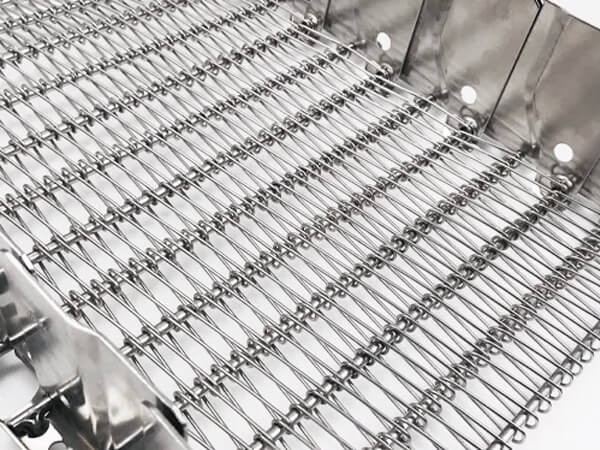
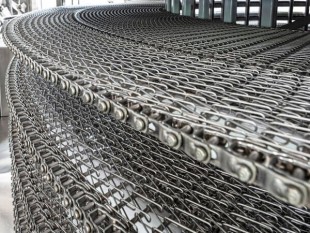
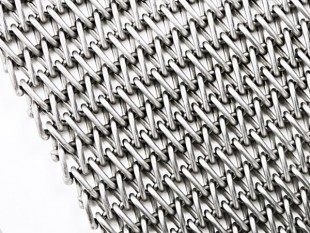
A self-stacking spiral freezer belt is a stainless steel wire mesh belt engineered to carry its own weight in a helical stack inside a spiral freezer tower. The stacking elements of each belt tier rest on the corresponding supports of the tier immediately below, creating a self-supporting vertical column — no external rotating cage, guide rail, or separate support structure is required. Each tier supports the tier above it, allowing dozens of belt levels to occupy a compact vertical footprint without external intervention.
Products travel along a continuous upward (or downward) spiral path while cold air circulates freely through the open wire mesh, ensuring even temperature distribution across all product surfaces for consistent IQF (Individual Quick Freezing) results. The stable self-supporting geometry also helps reduce belt flipping and edge distortion that are common failure modes on conventional drum-driven spiral systems.
Q2. What is the difference between a self-stacking spiral belt and an edge-drive spiral belt?
Both belt types are used in spiral freezer applications; self-stacking describes tier support, while edge drive describes how driving force is applied:
Self-Stacking Spiral Belt (self-supporting tiers): The belt's stacking elements support the tier above. The drive arrangement must match the freezer design; self-stacking does not mean that a central friction drum is required. Belt tension is very low because load is distributed across the belt structure rather than pulled from a single drive point. This reduces motor power demand and belt wear. Best suited for lighter-weight food products where IQF throughput and compact footprint are priorities.
Edge Drive Spiral Belt: Driven by sprockets or chains engaging at the belt's side edges, providing positive, synchronised drive speed at both edges. Offers more precise dwell-time control and handles heavier or irregular product loads more reliably. Typically used in systems requiring tight speed regulation or processing denser products.
PFM Screen manufactures both types.
See our Edge Drive Spiral Freezer Belts page for specifications and applications. Contact us with your system type and product details and we will recommend the correct belt configuration.
Q3. What specifications do I need to provide when ordering a self-stacking spiral freezer belt?
To manufacture a self-stacking spiral belt that fits your system, please provide the following parameters:
• Belt width (mm) — standard options: 420, 580, 640, 760, 920, 1060 mm; custom widths available
• Coil wire diameter (mm) — available in 1.5, 1.6, 1.7, 1.8 mm
• Coil pitch (mm) — range 6.0 – 20.0 mm
• Cross rod diameter (mm) — 5.0, 6.0, or 7.0 mm
• Cross rod pitch (mm) — standard 30 mm
• Tier height (mm) — 60, 80, 100, or 120 mm
• Operation direction — clockwise, counter-clockwise, or dual direction
• Material grade — SS 304 or SS 316L
• Total belt length (m) and number of tiers (for replacement orders)
• OEM spiral freezer brand and model (if ordering a replacement for an existing system)
Download our
Self-Stacking Spiral Belt Enquiry Form and send it to
[email protected] for a structured quote request.
Q4. Should I choose SS 304 or SS 316L for my spiral freezer belt?
Both grades meet food-contact hygiene requirements, but they are optimised for different environments:
SS 304 (AISI 304): Standard austenitic grade. Excellent corrosion resistance against water, mild detergents, and standard alkaline cleaning chemicals. Cost-effective for most frozen food applications including vegetables, poultry, bakery, and dairy lines where contact with salt brine or acidic marinades is minimal.
SS 316L (AISI 316L): Molybdenum-alloyed, low-carbon grade (Mo 2–3%; C ≤ 0.03%). The molybdenum content provides significantly superior resistance to chloride pitting and crevice corrosion in salt brine, seafood liquids, and acidic marinating solutions. The low-carbon specification preserves weld integrity at the belt's edge joins — an important stress point in spiral freezer applications. Strongly recommended for seafood, marine protein, smoked fish, or any brine-contact processing environment.
Q5. Can PFM Screen's self-stacking spiral belts replace existing OEM belts without modifying the spiral freezer system?
In most cases, yes. PFM Screen manufactures self-stacking spiral belts to match the original belt's wire diameter, coil pitch, cross rod pitch, tier height, and belt width. Replacement sections are joined to the existing belt at a splice point using standard coil-and-rod assembly — no modification to the spiral freezer tower structure is required.
Partial belt replacement via splice-in allows sections of worn or damaged belt to be renewed during a scheduled maintenance stop without extracting the full belt from the tower, significantly reducing downtime and replacement cost.
To confirm compatibility, please provide your spiral freezer system brand, model, and current belt specifications (or a sample of the existing belt if available). Our engineering team will verify a drop-in fit before production begins.
Q6. What maintenance do self-stacking spiral freezer belts require?
Self-stacking spiral belts have fewer moving mechanical components than chain-driven alternatives, resulting in lower routine maintenance demands. Key recommended practices include:
• Visual inspection of tension links and edge coils: Check for signs of fatigue, deformation, or pitting corrosion — particularly at the belt edges and splice points, which experience the highest stress.
• Splice joint integrity: Verify coil-to-coil joints and cross rod end retention after high-pressure wash-down cycles, as water pressure can displace poorly secured rod ends over time.
• Belt tracking: Confirm the belt runs centered in the spiral tower without lateral drift. Persistent drift can indicate uneven wear on edge coils or tier-height inconsistency.
• Cleaning: The open mesh structure supports thorough high-pressure wash-down using food-safe caustic or acid cleaners following HACCP-compliant protocols. Ensure complete drainage after each cleaning cycle.
• Inspection interval: For continuous-operation systems, a detailed inspection every 500–1,000 operating hours may be used as a planning reference, subject to the equipment manufacturer’s instructions and operating conditions. Routine visual checks should also be included in start-up and sanitation procedures.
Q7. Which food products are typically processed on self-stacking spiral freezer belt systems?
Self-stacking spiral belts are a standard choice for IQF (Individual Quick Freezing) lines across a wide range of food categories:
• Vegetables and fruits: Peas, corn kernels, cut beans, berries, diced fruit — open mesh enables cold air to freeze individual pieces without clumping; 60 mm tier height common for small-diameter product.
• Meat and poultry: Nuggets, formed patties, strips, diced cuts — high-throughput configurations with 80–100 mm tier heights; self-stacking design handles consistent product shapes efficiently.
• Seafood: Shrimp (raw and cooked), fish fillets, crab portions — SS 316L recommended for salt brine or acidic marinating environments; 80 mm tier height for most fillet sizes.
• Bakery: Par-baked rolls, pastries, dough pieces, cream cakes — the gentle open-mesh surface prevents sticking and product deformation; 100–120 mm tier height for tall baked items.
• Dairy and ice cream: Cheese portions, butter pats, ice cream novelties — hygienic stainless steel surface; fully drainable after wash-down; allergen changeovers require validated cleaning and verification.
• Ready-to-eat meals, pizza, and snacks: Rapid hardening from ambient to −18°C in a compact tower footprint; suitable for high-mix, multi-SKU production environments.
Still have a question about your self-stacking belt?
Send your equipment model and belt details. Include photos, operating conditions and your replacement requirements.
 +86-15369679157